Mixed in Key Alternative for DJs: Key Detection Software Compared
An honest comparison of key detection: what to look at, what accuracy to expect and what happens to your tracks after the analysis.
By Ariel Contreras · November 2026 · 8 min read
For years Mixed in Key was the reference for analyzing the key of a library. Today there are more options, and the question has changed: it is no longer only who gets more keys right, but what happens to your tracks once they are analyzed.
This guide compares what matters when you choose: accuracy, workflow, compatibility and how a doubtful analysis gets fixed. At the end, when it makes sense to keep what you already use and when to try something else.
Quick answer
If you are looking for a Mixed in Key alternative, check three things: accuracy (measured by ear, not by marketing), what happens to the track after the analysis, and which programs it works with. In our test, DJ Harmonic Studio gets the key right on 85% of tracks, the same accuracy as Mixed in Key, and adds a faster workflow: one-key editing, energy stars from 1 to 5 as in Rekordbox, and compatibility with Rekordbox, Serato, Traktor, VirtualDJ and Engine DJ.
Why look for a Mixed in Key alternative?
Hardly anyone switches analyzers for no reason. These are the reasons DJs mention most:
- The workflow. Analyzing is one step; what takes hours is what comes after: renaming, sorting by energy, fixing doubtful tracks and getting everything into your DJ software.
- The system. Some DJs work on Linux or want a single tool that behaves the same on Windows, Mac and Linux.
- The energy scale. If the analyzer’s scale is not the one in your DJ software (for example 1 to 5 stars in Rekordbox), the labels do not match afterwards.
- Trying it with no commitment. Before running your whole library through a program, it pays to check with your own tracks how well it does.
What to compare in key detection software
Before looking at names, define what you need. Five criteria are enough to compare any option:
- Accuracy measured by ear. Ask for the method, not only the percentage. A test with real tracks checked by ear says more than a loose number.
- How it reaches your DJ software. Key and energy should arrive in the same format in Rekordbox, Serato, Traktor and the rest, for example with the same star scale.
- Energy and order. Being able to filter by energy and style saves more time than the analysis itself.
- Workflow speed. How long it takes from loading the folder to having it ready, and how much it costs to fix a doubtful track: no analyzer gets every one right.
- Compatibility. It should export to what you already use: Rekordbox, Serato, Traktor, VirtualDJ or Engine DJ.
Accuracy: what to expect from Mixed in Key and the other options
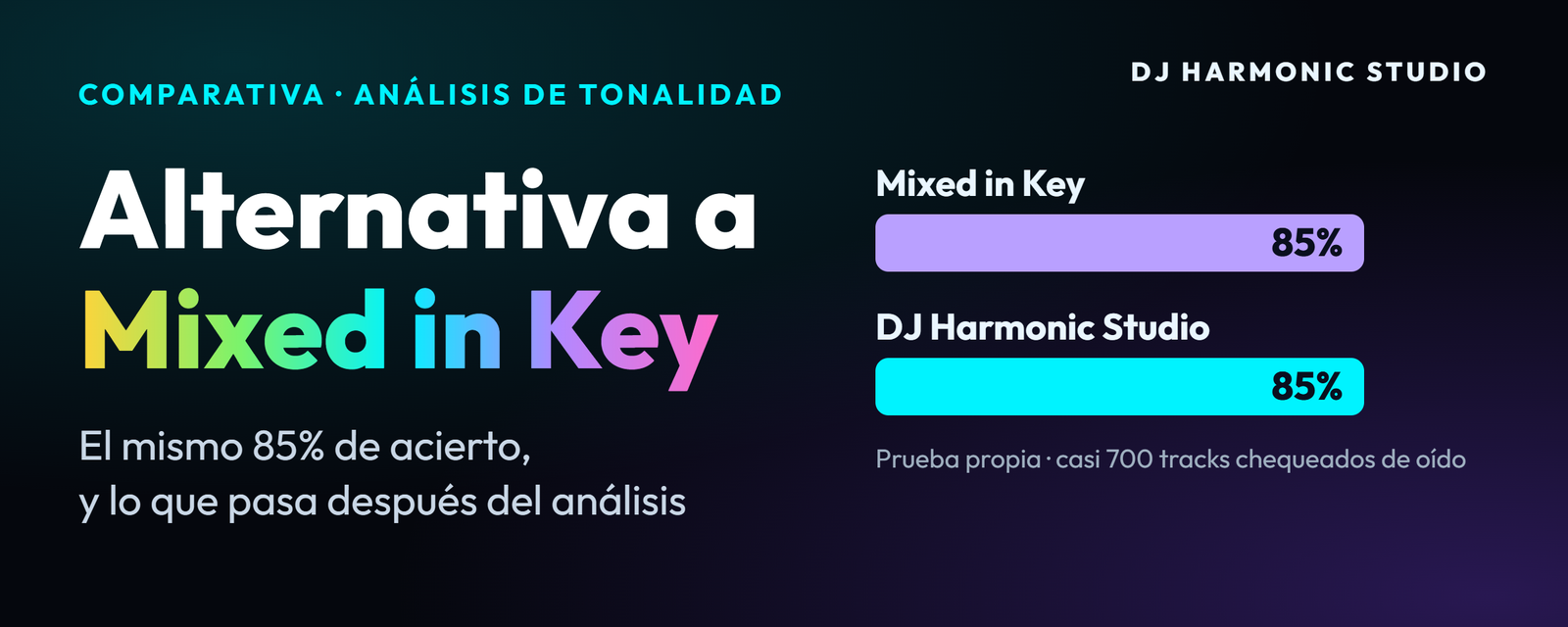
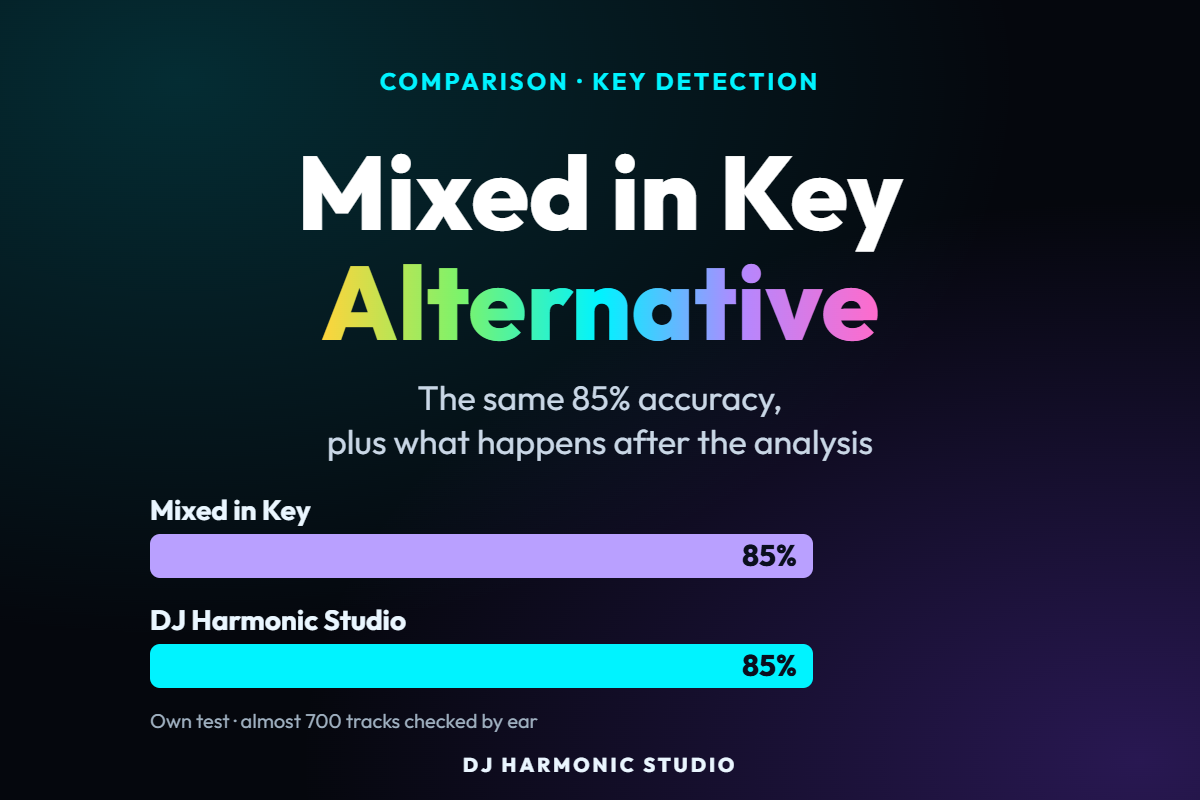
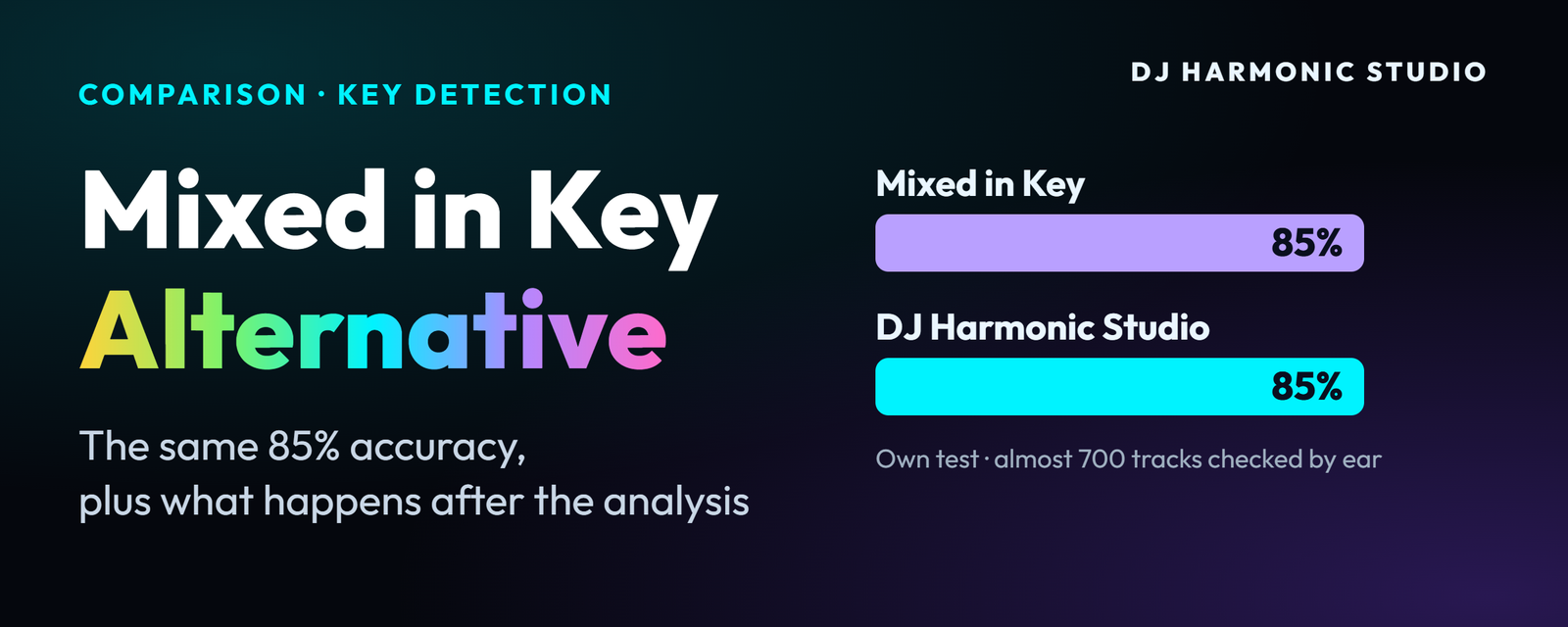
In our own test with almost 700 tracks checked by ear, DJ Harmonic Studio got the key right on 85% of them, the same accuracy as Mixed in Key. The analyzers built into DJ programs landed between 69% and 74%.
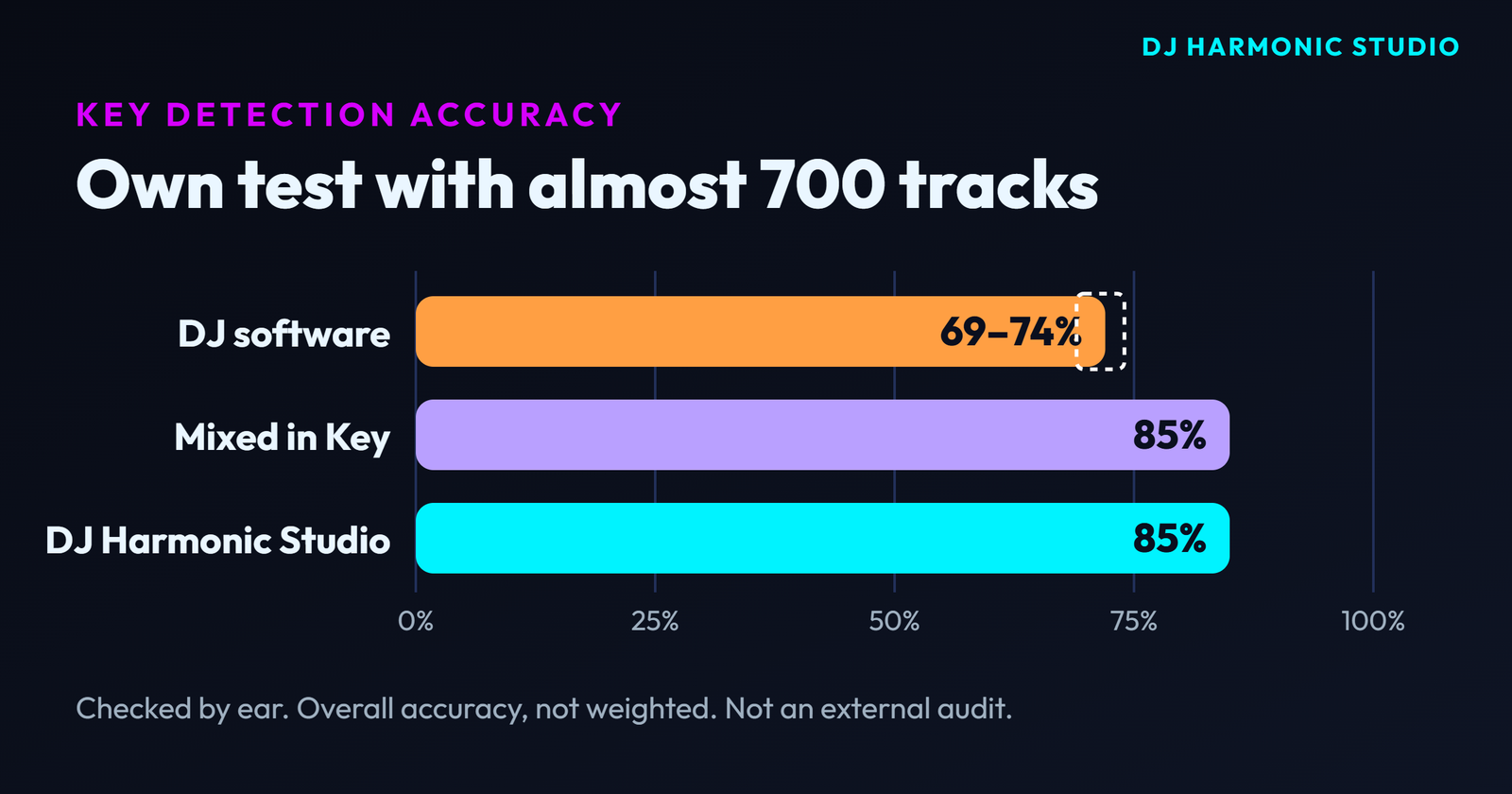
Own test by Ariel with almost 700 tracks checked by ear (overall accuracy, not weighted). Not an external audit.
With the same accuracy, the difference is not in the hit rate but in what you do with the result. That is where it pays to compare.
Mixed in Key vs DJ Harmonic Studio: comparison
| Criteria | Mixed in Key | DJ Harmonic Studio |
|---|---|---|
| Key accuracy* | 85% in the own test. | 85% in the own test. |
| Energy scale | 1 to 10 scale. | 1 to 5 stars, same as Rekordbox. |
| Sorting the library | Depends on how you set up your workflow. | Folders by energy, by style or Genre > Energy. |
| Workflow | Established reference for analysis. | Faster: analysis, renaming, folders and export in a single flow, with one-key editing. |
| Systems and programs | Windows and Mac. | Windows, Mac and Linux; compatible with Rekordbox, Serato, Traktor, VirtualDJ and Engine DJ. |
* Own test by Ariel with almost 700 tracks checked by ear (overall accuracy, not weighted). Not an external audit. Mixed in Key details are worth confirming on its official site, as they can change.
If you already analyzed your library with Mixed in Key, that result is still valid. The question is whether the rest of the workflow costs you hours.
What happens after the analysis
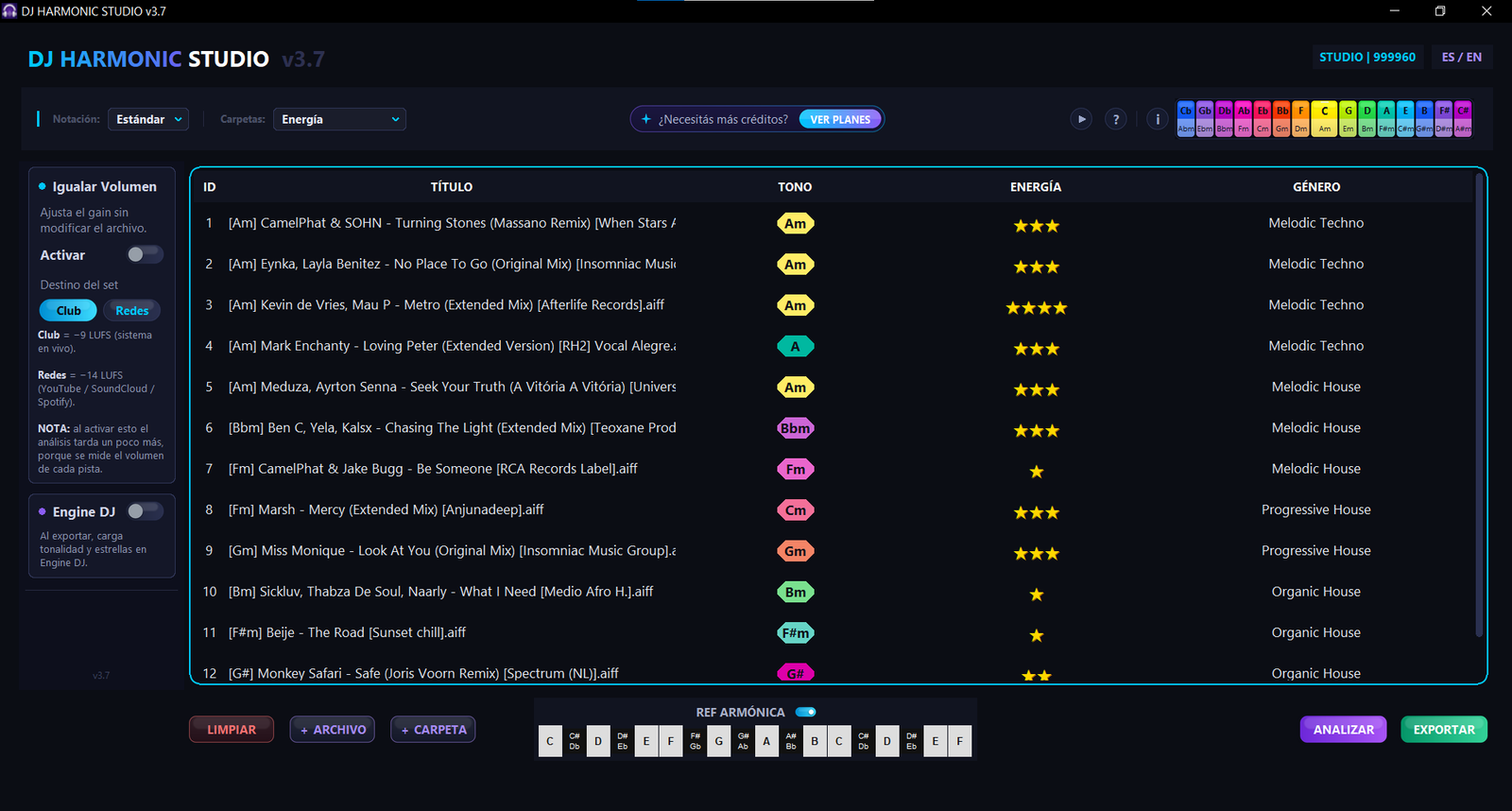
An analyzer that gets the key right leaves half the work done. The other half is sorting. DJ Harmonic Studio analyzes, renames, sorts your music into folders by energy and style and exports it ready for your DJ software, all in one flow.

- A workflow that is quick to apply. You analyze, fix and export without intermediate steps; changes take one key press.
- Energy from 1 to 5. The same star scale as Rekordbox, so the labels stay the same when you move to Rekordbox, Traktor and other programs, with no conversion.
- Folders by energy and style. You find the next track by function, not by name.
- One-key editing. You fix key or energy without leaving the list; the reference piano helps you confirm by ear.
How to switch analyzers without losing your library
- Make a copy. Work on a test folder, not on your whole library.
- Analyze 50 tracks. With the free trial of DJ Harmonic Studio you can analyze 50 tracks with no credit card.
- Check 20 tracks by ear. Compare the result with your ear and with the analysis you already have.
- Export to copies. Choose “create copy” when exporting to keep your original files.
- Decide with data. If the workflow saves you time, move on with the full library.
A real caution
In Rekordbox, if a track already has hot cues and you overwrite it, they are lost. That is why the “create copy” mode exists: use it when you export to Rekordbox. In Serato, Traktor and VirtualDJ this does not happen.
When it makes sense to stay with Mixed in Key
There are cases where nothing needs to change: if your library is already analyzed, your workflow works and you use a system that supports it, the same accuracy does not justify switching for the sake of it.
It makes sense to try another option when you spend more time sorting than choosing music, when the energy scale does not match your DJ software, or when you need it to work on Linux or export to several programs at once.
Our take
With the same accuracy as Mixed in Key, DJ Harmonic Studio is the most logical choice if you want a workflow that is fast and simple to apply: one-key editing of energy and key, automatic renaming and folders by energy and style save hours per session for any DJ, beginner, intermediate or pro, compared with other analysis software. It also uses 1 to 5 stars, like Rekordbox, and works with Rekordbox, Serato, Traktor, VirtualDJ and Engine DJ. Try it with your own tracks, 50 free.
Why DJ Harmonic Studio was born
As a musician I always made sure my tracks were well analyzed. When I noticed that the programs got keys wrong, I worked everything out by ear and wrote the key by hand at the start of every track. That gave me an edge, but it cost hours.
In January 2026 I started developing DJ Harmonic Studio so I would stop losing that time, and I launched it at the end of March, after seeing the results it gave me.
Frequently asked questions
It depends on what you need. If you want the same accuracy (85% in our test) with a faster workflow, 1 to 5 stars like Rekordbox and compatibility with five DJ programs, DJ Harmonic Studio is the most logical choice.
With DJ Harmonic Studio you can analyze 50 tracks for free, with no credit card, and check the result on your own library before you decide.
Yes. DJ Harmonic Studio runs on Mac (Intel and Apple Silicon), Windows and Linux.
It is a serious reference and it reached 85% accuracy in our test. If it works for you and your library is ready, there is no need to switch. If the problem is workflow speed or an energy scale that does not match your DJ software, try another option with your own tracks.
85% key accuracy, the same as Mixed in Key, in our own test with almost 700 tracks checked by ear. It is not an external audit and no analyzer gets every track right, which is why a wrong key is fixed with one key press.
Yes, and also with VirtualDJ and Engine DJ. In Rekordbox use the “create copy” mode so you do not lose hot cues.
Yes. You can write it as notes (Am, C, F#m) or as Camelot. To understand the difference, read the guide on the Camelot wheel vs circle of fifths.
Try it with your library
Analyze your first 50 tracks free
Analyze, rename and sort your music into folders by energy and style, ready for Rekordbox, Serato, Traktor, VirtualDJ or Engine DJ.
Instant download · No credit card · Windows, Mac and Linux · Optimized for electronic music
About me
Ariel Contreras
I studied a Bachelor’s in Music with a focus on Composition and a Technical Degree in Arrangement, and I have played piano and synthesizer since 2007. I have always been a composer, in other musical styles; in 2018 I ventured into electronic music, blending it with other genres, and since 2022 I have focused fully on electronic music production: my latest EP reached #27 in Melodic House on Beatport. I have been a DJ since early 2024. Between 2025 and 2026 I helped more than 235 people understand harmony for their mixes and productions.
I created DJ Harmonic Studio, which more than 1,400 DJs have used. Try it free with your library: it is available for Windows, Mac and Linux and optimized mainly for electronic music.