Etiqueta: dj harmonic studio

  • Camelot Wheel vs Circle of Fifths: Which One Should DJs Use?

    Camelot Wheel vs Circle of Fifths: Which One Should DJs Use?

    Harmonic mixing

    Camelot Wheel vs Circle of Fifths: Which One Should DJs Use?

    They describe the same map of keys, but one gives you a label and the other gives you judgment. What the difference is, and which one to learn if you want to mix better.

    By Ariel Contreras  ·  November 2026  ·  7 min read

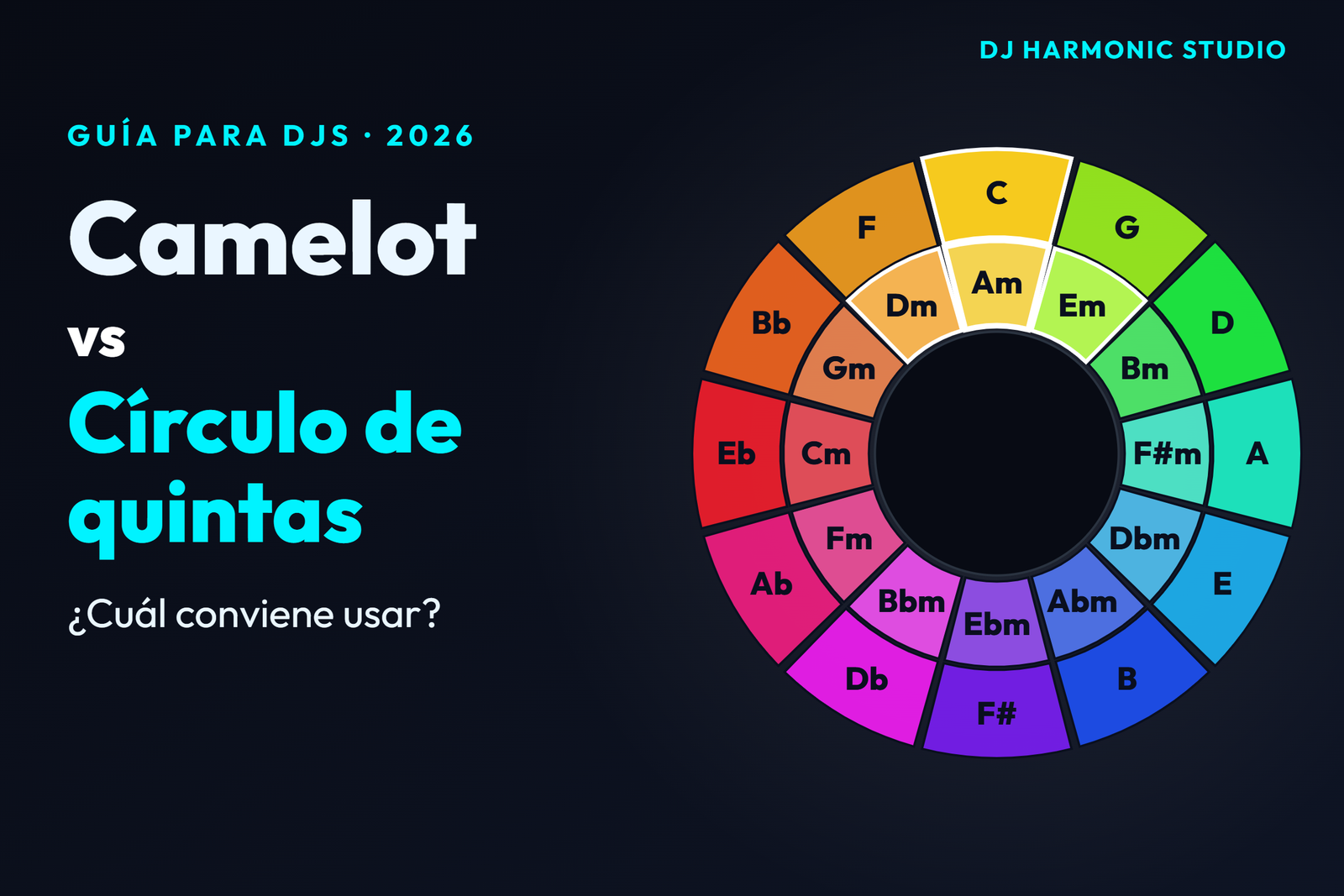
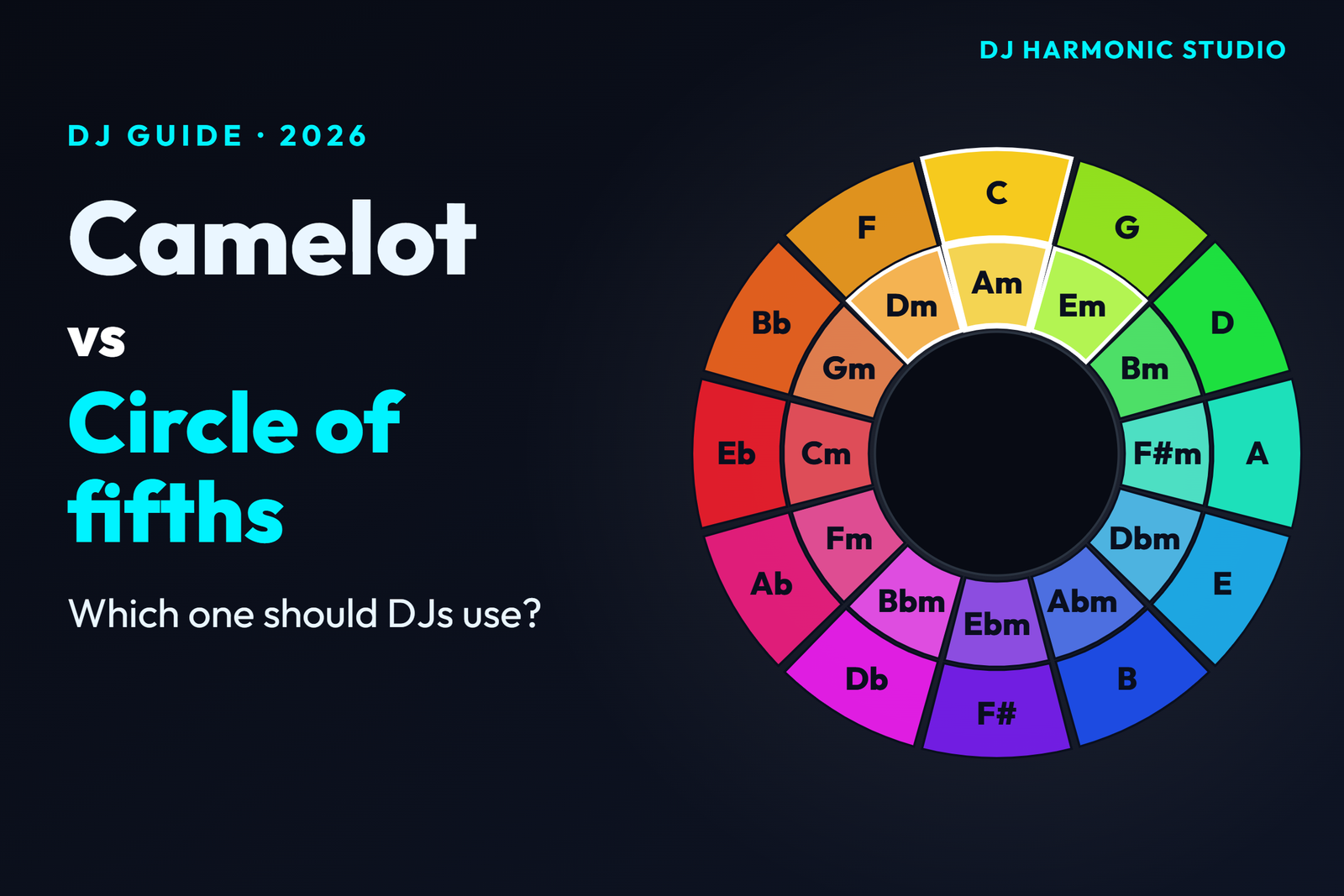
    Camelot wheel with codes next to the circle of fifths with notes, both in color

    A question keeps coming up among DJs: are the Camelot wheel and the circle of fifths different things, and which one should you use? The short answer: they are the same map, but what you gain from reading it changes.

    Either way, you need the key of every track. DJ Harmonic Studio writes it for you in the title, in notes or in Camelot, for your whole library in one click.

    Quick answer

    The Camelot wheel and the circle of fifths represent the same thing: the 24 keys arranged by fifths. Camelot numbers them (8A, 8B) and the circle names them (Am, C). For quick decisions on the deck, the code is enough; to understand why a mix works and carry it into production, the circle of fifths read in notes is the better choice.

    They are the same map with two labels

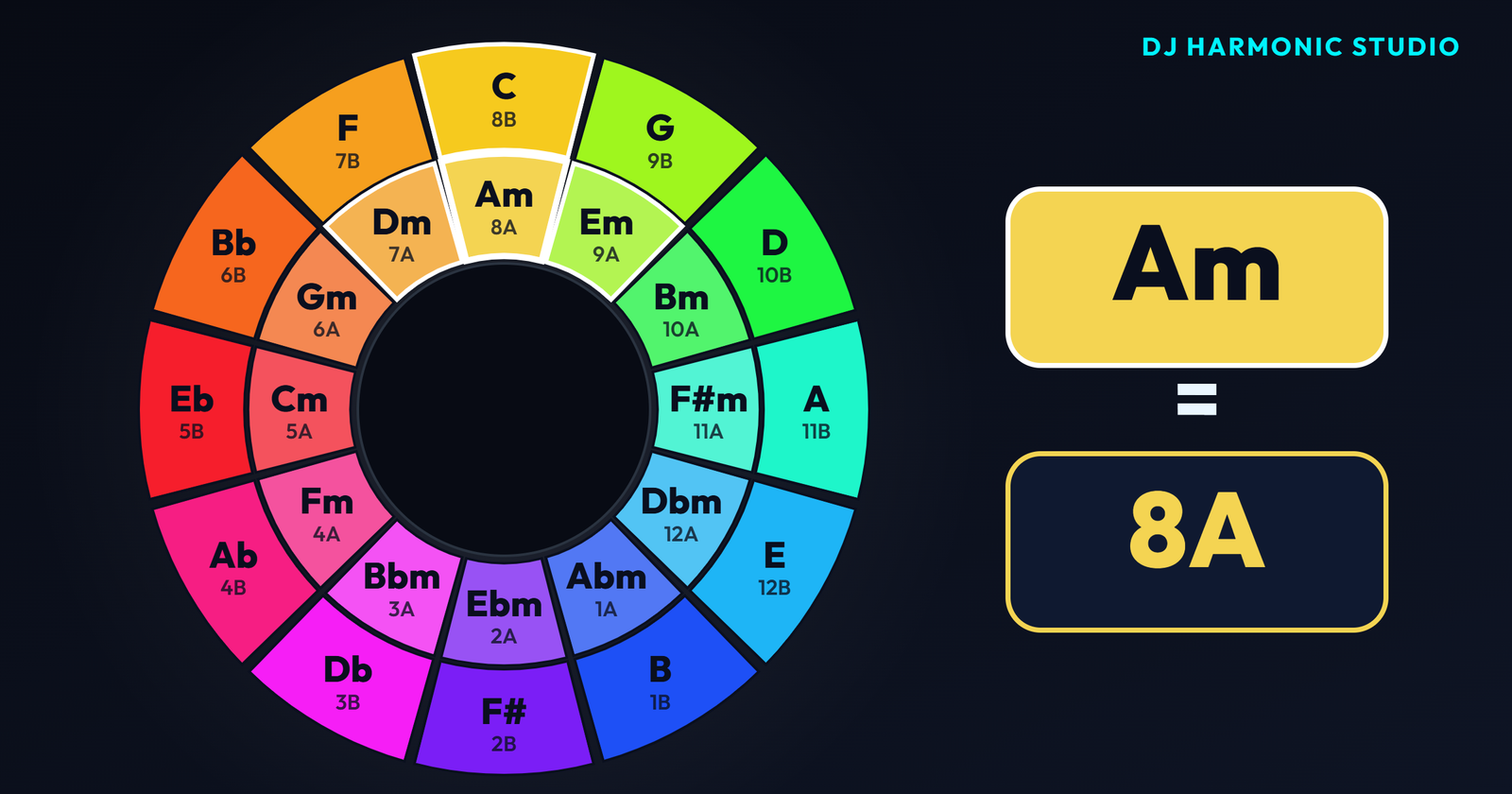
    Both arrange the 12 notes a fifth apart, with the outer ring for major keys and the inner ring for their relative minors. The only difference is how each cell is labeled:
    Círculo de quintas con cada casilla rotulada con su nota y su código Camelot: Am es 8A
    The same circle, with each cell labeled with its note and its code.
    • Camelot wheel: each cell carries a number from 1 to 12 and a letter (A for minor, B for major). Am is 8A and C is 8B.
    • Circle of fifths: each cell carries the name of the key. Am is A minor and C is C major.

    That is why mixing with Camelot (same number, one step sideways, letter swap) and mixing with the circle (same key, a fifth up or down, relative) are exactly the same moves.

    What is the Camelot wheel and what is it for?

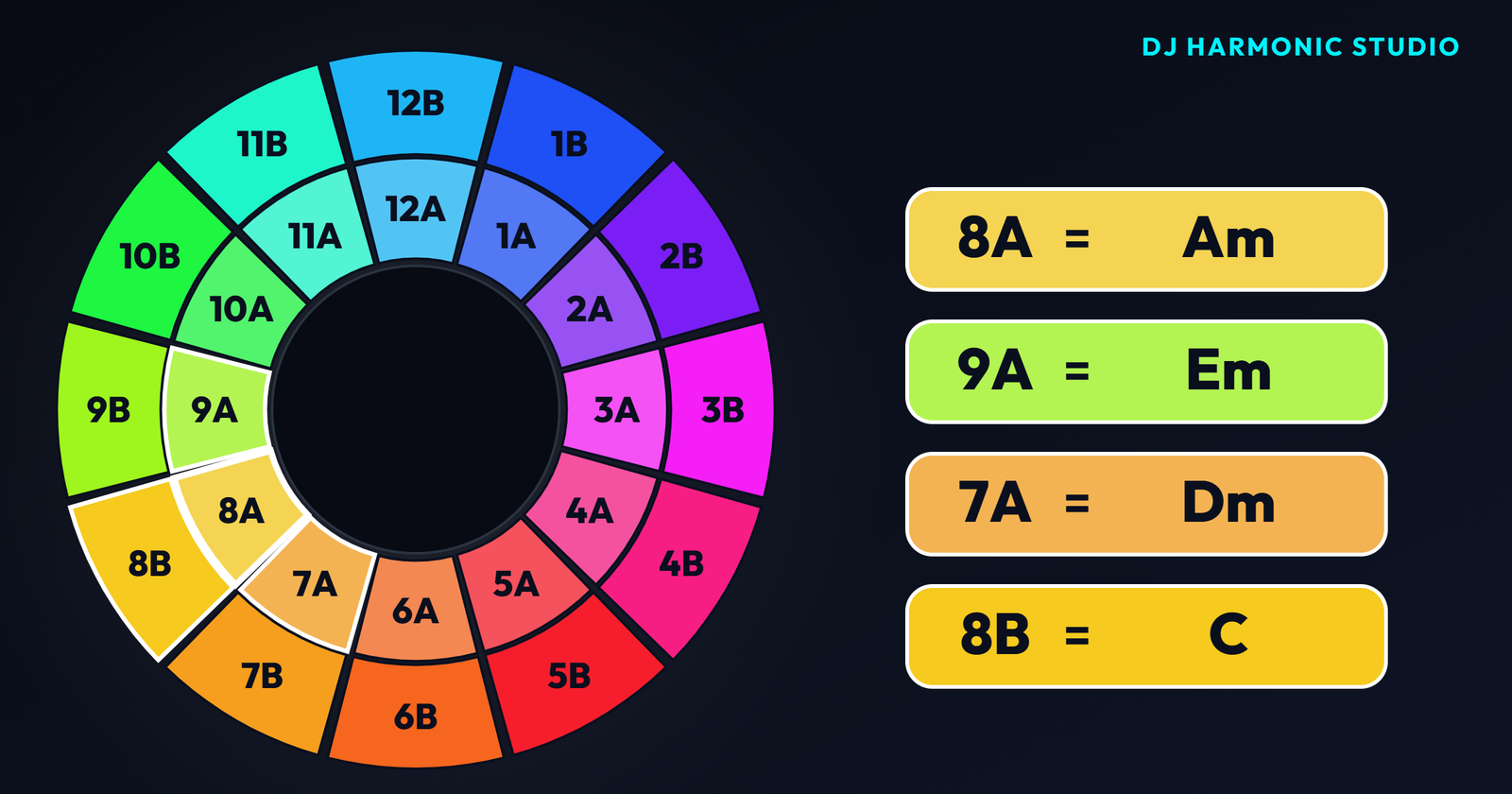
    It is a code system created by Mark Davis of Camelot Sound and popularized by Mixed in Key. It can be shown in programs like Rekordbox or VirtualDJ, and Traktor uses a variant called Open Key. It helps you decide fast: if what is playing is 8A, the candidates are 7A, 9A and 8B.
    Rueda de Camelot de colores con 8A resaltada y sus equivalencias en notas: 8A es Am, 9A es Em, 7A es Dm y 8B es C
    The Camelot wheel is the same circle with codes: 8A is Am, 9A is Em, 7A is Dm and 8B is C.

    Its big advantage is reading speed: a number and a letter read at a glance, with no music theory needed.

    Where a code stops

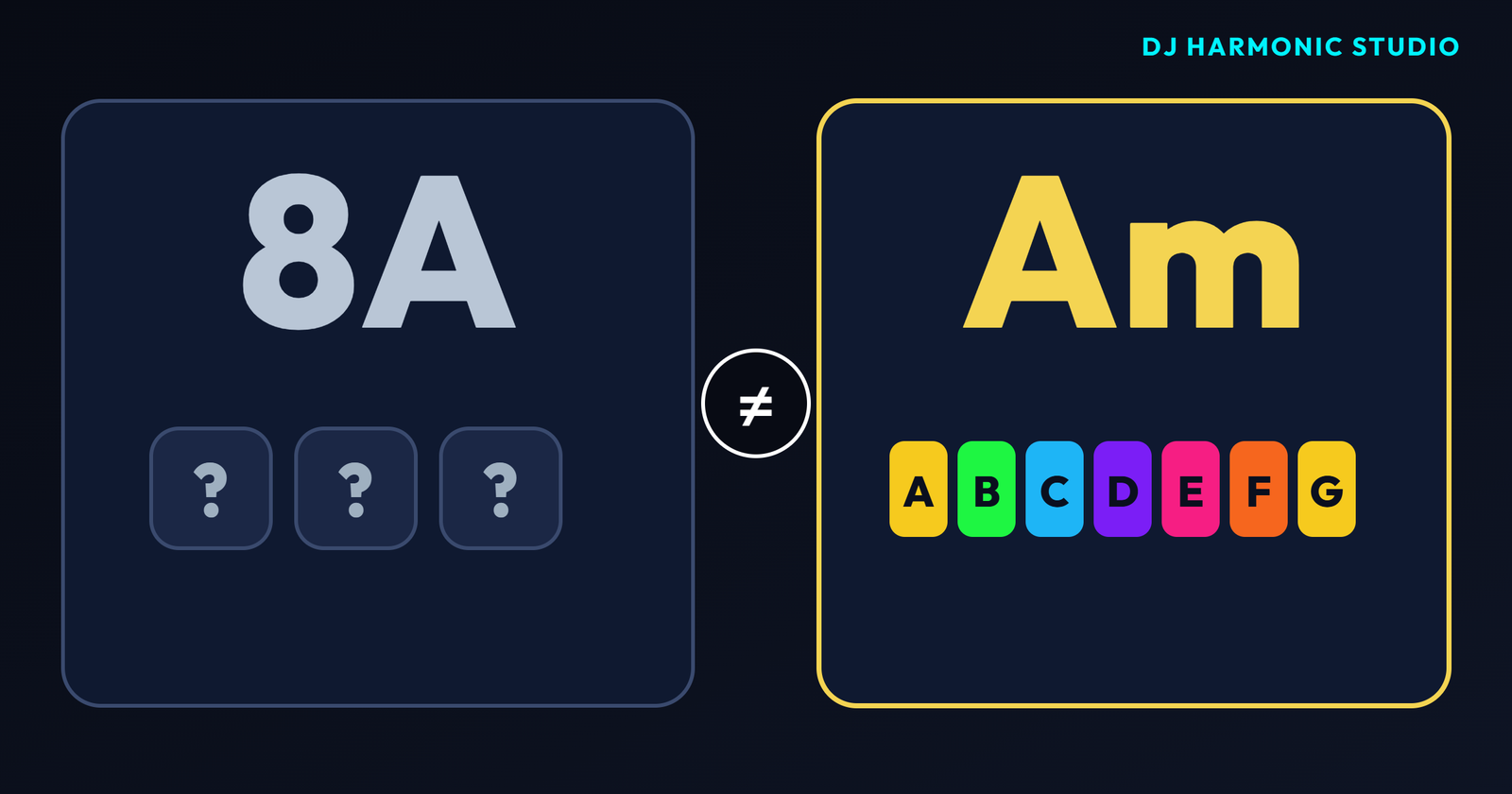
    The problem is what a code does not tell you:
    Comparación: el código 8A no muestra qué notas tiene y la nota Am sí muestra sus siete notas A B C D E F G
    A code does not show which notes the track has; the note does.
    • Which notes the track has, or which ones it shares with the next one.
    • Why two keys work together, or when they will rub.
    • How to take it to a keyboard, a DAW or a conversation with another musician.
    • What to do when the move is not enough: a bassline a semitone apart, or a melody that insists on a note that changes.

    There is also more than one numbering of the same circle (Camelot, Open Key and others). If you switch programs, 8A in one can be a different number in the other. Notes, on the other hand, are the same everywhere. That is the whole Camelot wheel vs Open Key story: same circle, different numbers.

    What the circle of fifths gives you in notes

    Read in notes, the circle gives you what the code hides: you see right away what is going on.

    Las notas de Am y Em: comparten seis y solo cambia una, F pasa a F#
    From Am to Em they share six notes and only one changes: F becomes F#.
    • Neighbors share almost all notes: two adjacent keys share six of their seven notes.
    • You know what changes: from Am to Em only one note changes, F becomes F#.
    • You see the risk: if the outgoing track’s melody insists on F, the incoming track in Em will rub.
    • It works outside the booth: chords, cadences, basslines and progressions in production are the same circle.

    With notes, mixing stops being obeying a label and becomes an informed decision.

    The same case, two readings

    Imagine a track in Am is playing and you want to move to one in Em. Here is how each system sees it:

    With codes

    8A → 9A
    Camelot: position 8 → position 9

    You know it is compatible. You do not know what changes or where it can rub.

    With notes

    Am → Em
    A minor → E minor

    You know exactly one note changes (F becomes F#). If the lead insists on F, you know where to listen.

    Comparison: Camelot wheel vs circle of fifths

    CriteriaCamelot wheelCircle of fifths (notes)
    First readingVery fast: a number and a letterYou need to learn the notes of the circle
    What it tells youWhether two keys are neighborsWhich notes they share and what changes
    Explains why it worksNoYes
    Useful beyond DJing (keyboard, DAW)NoYes
    Across programsSeveral numberings (Camelot, Open Key)The same notes everywhere
    Learning curveAlmost noneA little at first, then it becomes automatic

    Camelot wins the first minute; the circle wins the more you use it.

    Which one should you use?

    Our recommendation

    Learn the circle of fifths in notes and use Camelot codes as a shortcut in the meantime. Codes tell you what to do; notes tell you why, and that is what lets you decide when the label is not enough.

    That is also why DJ Harmonic Studio writes the key at the start of the title in notes (Am, C, F#m) and lets you choose Camelot if you prefer. Try it with 50 free tracks.

    Camelot wheel with notes: conversion chart

    If you come from codes, this camelot wheel chart works as a bridge. Minor keys carry the letter A and major keys the letter B.

    Minor keys (letter A)
    Abm1AEbm2ABbm3AFm4ACm5AGm6ADm7AAm8AEm9ABm10AF#m11ADbm12A
    Major keys (letter B)
    B1BF#2BDb3BAb4BEb5BBb6BF7BC8BG9BD10BA11BE12B

    Some programs write C#m instead of Dbm or G#m instead of Abm: it is the same note.

    How to move from codes to notes without losing speed

    1. Write the key in notes in every track title. With DJ Harmonic Studio it is automatic: [Am] Artist - Track.
    2. Keep the conversion chart handy for the first few sessions, as a bridge.
    3. Practice with the three neighbors of a key: a fifth up, a fifth down and the relative. With Am they are Em, Dm and C.
    4. When in doubt, listen. The analysis can be wrong and your ears have the final say.
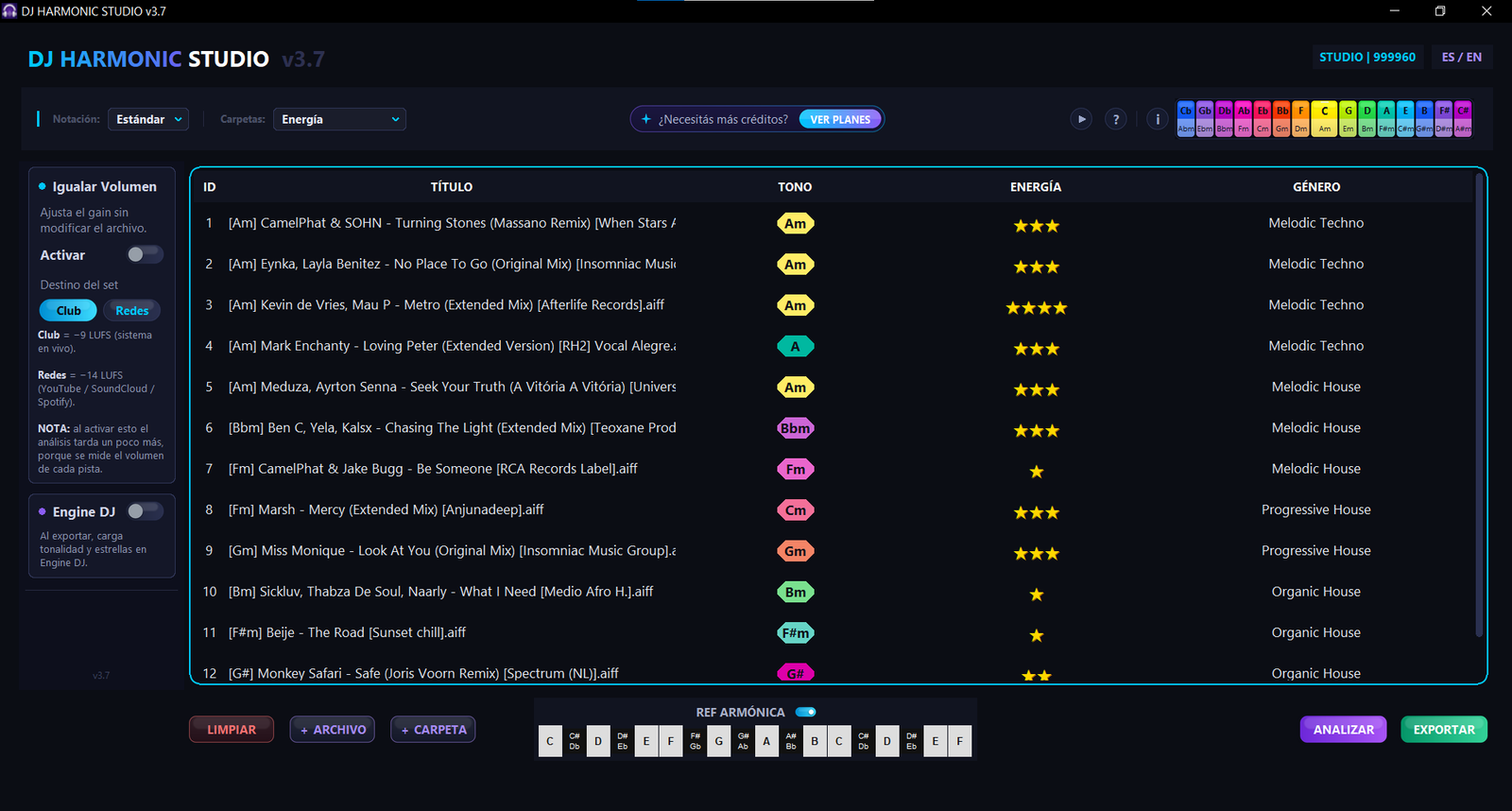
    Pantalla de DJ Harmonic Studio con una lista de tracks analizados: tonalidad, energía de 1 a 5 en estrellas y género de cada uno
    DJ Harmonic Studio shows key, energy from 1 to 5 and genre for every track on a single screen (Spanish interface shown; the app also runs in English).

    Common mistakes

    • Treating the code as a rule. It is a map: compatible does not mean it sounds good.
    • Repeating the same move in every change. Energy stalls and the set gets predictable.
    • Ignoring the basslines. Two neighboring keys can clash if the basses end up a semitone apart.
    • Mixing numberings. Do not confuse Camelot with Open Key when reading codes from another program.

    Frequently asked questions

    Yes. They arrange the same 24 keys by fifths. The Camelot wheel labels them with codes (for example, 8A) and the circle of fifths with notes (for example, Am).

    The circle of fifths read in notes: it shows which notes two tracks share, explains why a mix works and also applies on the keyboard and in production. Camelot codes work as a shortcut while you get used to it.

    It is a code system for the 24 keys, created by Mark Davis of Camelot Sound and popularized by Mixed in Key. Each key gets a number from 1 to 12 and a letter: A for minor and B for major.

    With a conversion chart: letter A means minor and B means major. For example, 8A is Am, 9A is Em, 7A is Dm and 8B is C. The full chart is earlier in this article.

    It is another numbering of the same circle of fifths, used by Traktor. The numbers and letters differ from Camelot, but the logic is the same.

    Rekordbox lets you pick how the key is displayed in its preferences (classic notes or alphanumeric codes). The simplest alternative is to write the key in notes in the track title, which DJ Harmonic Studio does automatically.

    You choose: standard notation (Am, C, F#m) or Camelot. It also renames the track with the key at the start of the title, so you see it on the deck in Rekordbox, Serato, Traktor, VirtualDJ and Engine DJ. It has 50 free tracks to try.

    Yes. DJ Harmonic Studio analyzes key, energy and genre, renames your tracks and sorts them into folders. In Ariel’s own test with almost 700 tracks checked by ear it reached 85% accuracy, the same as Mixed in Key.

    Try it with your library

    Analyze your first 50 tracks for free

    Get the key written in the title and your music in folders by energy and genre, ready for Rekordbox, Serato, Traktor, VirtualDJ or Engine DJ.

    Instant download · No credit card · Windows, Mac and Linux · Optimized for electronic music

    About me

    Ariel Contreras

    I studied a Bachelor’s in Music with a focus on Composition and a Technical Degree in Arrangement, and I have played piano and synthesizer since 2007. I have always been a composer, in other musical styles; in 2018 I ventured into electronic music, blending it with other genres, and since 2022 I have focused fully on electronic music production: my latest EP reached #27 in Melodic House on Beatport. I have been a DJ since early 2024. Between 2025 and 2026 I helped more than 235 people understand harmony for their mixes and productions.

    I created DJ Harmonic Studio, which more than 1,400 DJs have used. Try it free with your library: it is available for Windows, Mac and Linux and optimized mainly for electronic music.

    DJ Harmonic Studio  ·  © 2026 All rights reserved
  • Harmonic Mixing for DJs: The Circle of Fifths Guide

    Harmonic Mixing for DJs: The Circle of Fifths Guide

    Harmonic mixing

    Harmonic Mixing for DJs: The Circle of Fifths Guide

    How to read the circle of fifths to decide which track to mix next, and why it pays to think in notes (Am, C, Em) and stop depending on the Camelot wheel.

    By Ariel Contreras  ·  November 2026  ·  8 min read

    Colorful circle of fifths with major and minor keys over audio waveforms

    You are mid-set. The next track matches the BPM perfectly and still sounds wrong. Two melodies fighting. The crowd notices. So do you.

    It comes down to something that gets checked too late: the key. Harmonic mixing uses it to decide which track can live next to which, and its tool is the circle of fifths. This guide shows how to read it in notes, when it is enough and when to trust your ears over the label. And if you want the key of every track sorted before you play, DJ Harmonic Studio analyzes your whole library in one click.

    Quick answer

    Harmonic mixing (also called key mixing) means blending tracks in compatible keys so melodies and basslines sit together during the transition. It relies on the circle of fifths: the same key, its two neighbors (a fifth up and a fifth down) and its relative (minor to major) are compatible. The Camelot wheel is that same circle, with numbers.

    What is harmonic mixing?

    Harmonic mixing, or key mixing, is the technique of mixing tracks in compatible musical keys, so melodies and basslines do not clash during the overlap. It is the difference between a transition that only lines up the beats and one that sounds like a single track.

    Why your mix sounds off even when the BPM matches

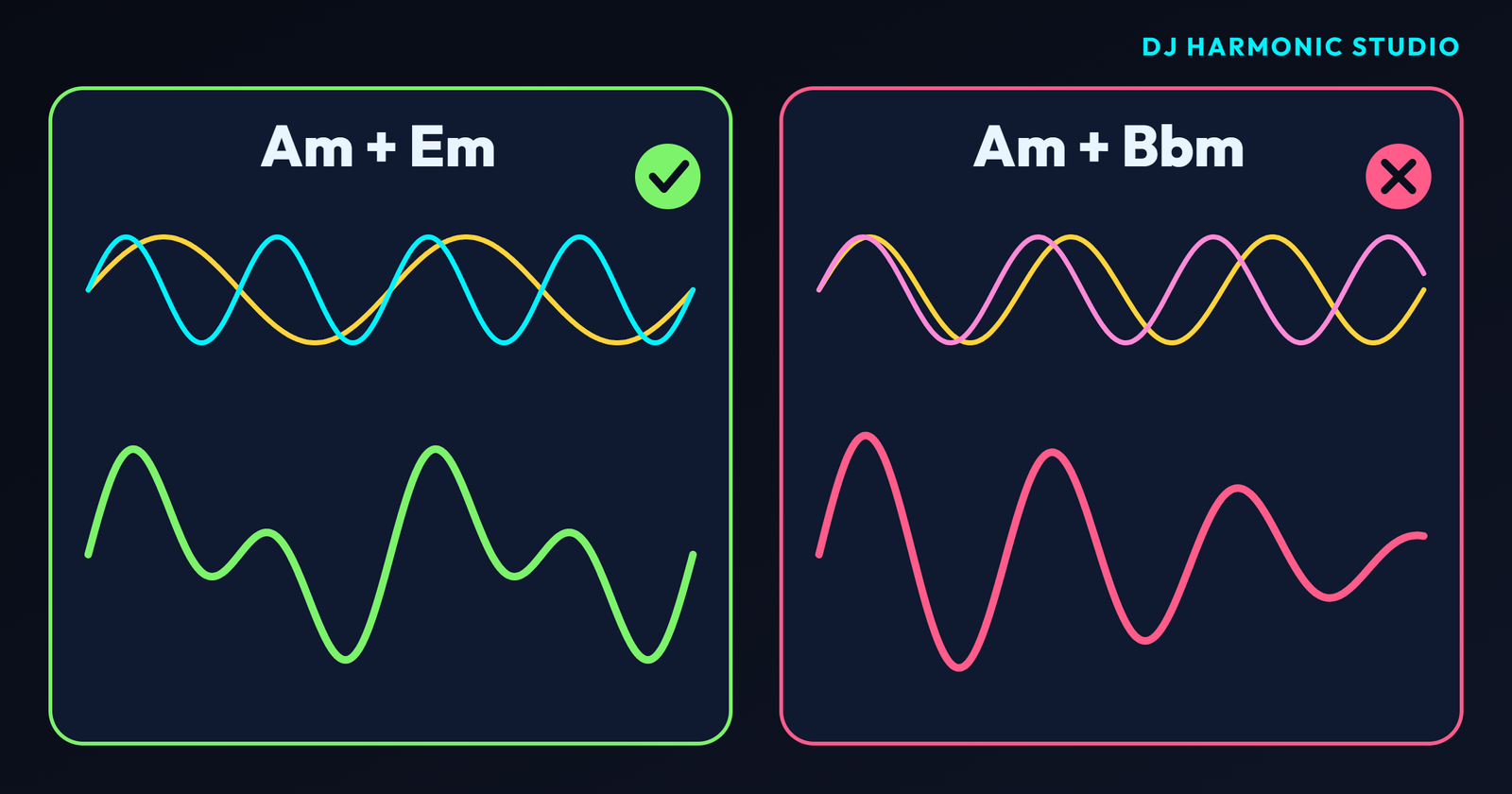
    BPM aligns the rhythm. Key aligns the melody and, above all, the bass. When two tracks play together their notes add up: if the basses end up a semitone apart, or a tritone or a major seventh appears between the voices, the ear hears a clash.

    Ondas de audio: Am con Em forman una onda regular y Am con Bbm una onda con cancelaciones que choca
    Two compatible keys add up to an orderly wave; two that clash do not.

    With compatible keys it is the opposite: the notes of one track fit inside the scale of the other, so you can let them overlap for longer. So, is harmonic mixing necessary? Not to play, but it is what makes long blends sound intentional.

    The circle of fifths: your harmonic mixing wheel

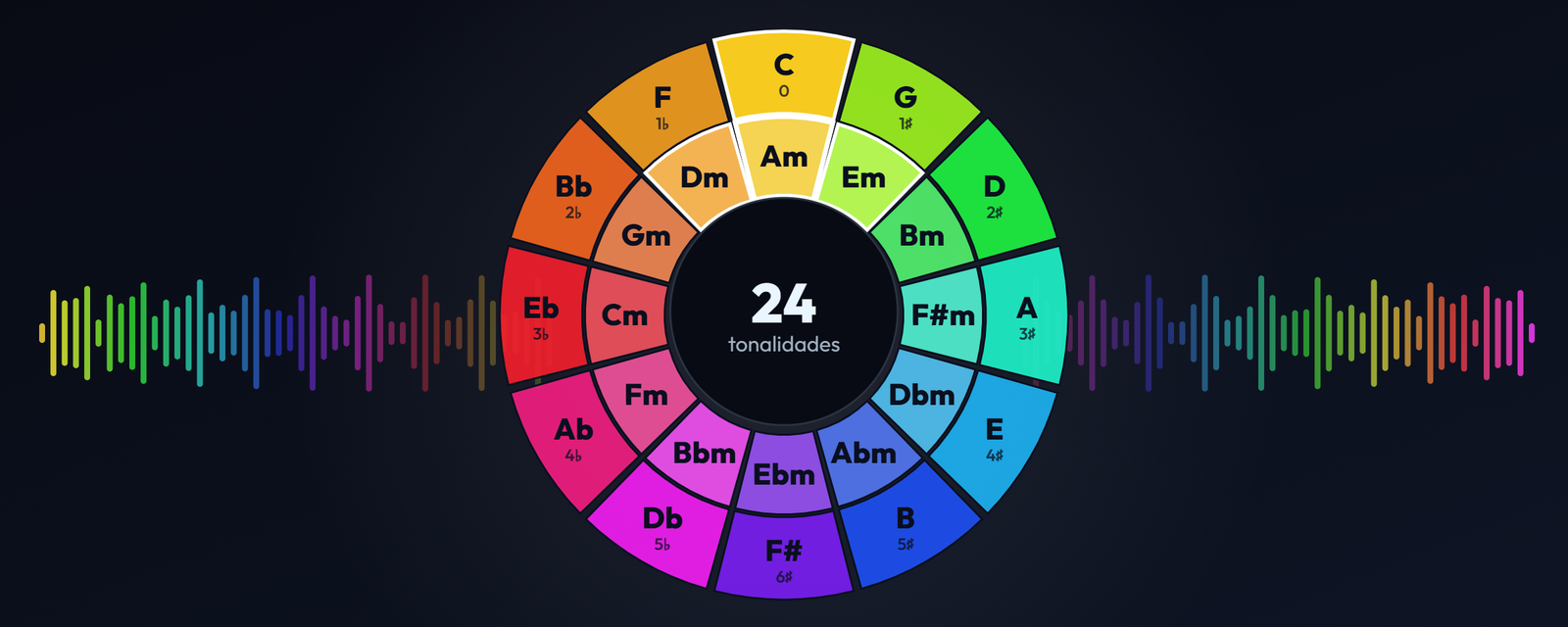
    The circle of fifths orders the 12 notes so that each step to the right goes up a fifth (C to G, G to D, D to A) and adds one sharp to the key signature. The outer ring holds the major keys and the inner ring their relative minors: Am sits under C because they share exactly the same notes.

    • Neighbors: two adjacent keys share six of their seven notes. C and G differ by a single note, F becoming F#.
    • Relatives: a major key and its minor share all seven notes, like C and Am.
    • Distance: the farther apart on the circle, the more different notes and the higher the risk of a clash.
    Colorful circle of fifths for DJs with all 24 keys; Am and its neighbors Dm, Em and C are highlighted
    With Am on the deck, the highlighted cells (Dm, Em and C) are its closest neighbors.

    This guide reads keys as notes (Am, C, F#m), the way a musician writes them and the way your track titles can show them. With a bit of practice the relationship between neighbors becomes obvious. If you know the Camelot wheel from Mixed in Key or Rekordbox, it gets its own section below.

    Four moves to start with

    When you are not sure where to go next, these four moves are a safe starting point:

    Círculo de quintas con los cuatro movimientos desde Am numerados del 1 al 4: misma tonalidad, quinta arriba, quinta abajo y relativa
    The four moves from Am: 1 same key, 2 a fifth up, 3 a fifth down and 4 relative.

    Same key

    Am → Am
    A minor → A minor

    The transition becomes almost invisible.

    A fifth up

    Am → Em
    A minor → E minor

    Lifts the energy smoothly.

    A fifth down

    Am → Dm
    A minor → D minor

    Drops the tension without killing the flow.

    Relative

    Am → C
    A minor → C major

    Same notes, different mood: minor to major.

    Energy boost

    Going up two fifths (Am → Bm) gives a clear energy boost. Save it for a drop.

    None of them is a guarantee: the analysis can be wrong, and two tracks in the same key can still clash if the bass and the melody do not get along. That is why your ears always get the final say.

    A five-track set, step by step

    Here is how it looks in a set. Five tracks, four transitions:

    Recorrido de un set de cinco tracks en el círculo de quintas: Am, Em, Bm, D y G
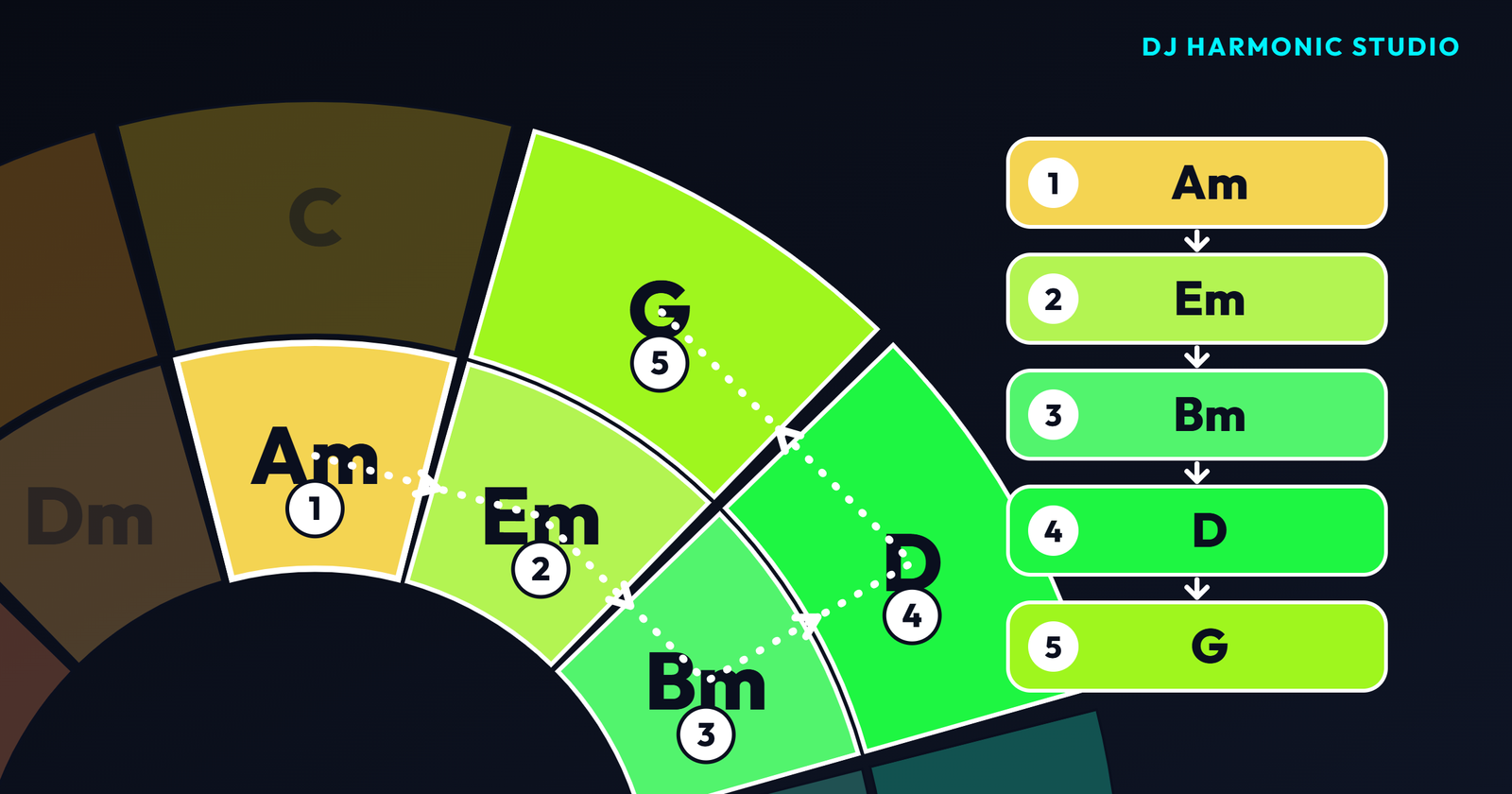
    The example set on the circle: from Am to G in four steps.
    Am5th ↑→Em5th ↑→Bmrelative→D5th ↓→G

    The arrow ↑ means a fifth up and ↓ a fifth down. The set climbs in energy, changes color when it moves to major and comes back down, all with one-step moves. What takes time is getting to that list with every track’s key already solved.

    Where it gets hard: the key is not in front of you

    With 100 new tracks, analyzing and renaming them by hand takes hours, and when you finish the key usually stays buried in the track’s info panel. On the deck you have to open it to know what you are mixing.

    Cien tracks con la tonalidad sin resolver y un reloj: analizarlos a mano lleva horas
    With 100 new tracks, working out the keys by hand takes hours.

    The result: you mix without risk, or you risk without knowing. Your ears are not the problem: the information is not where you need it. To skip the manual work, DJ Harmonic Studio analyzes the key, energy and genre of your whole library automatically.

    Camelot wheel explained (and where it fits)

    Programs like Mixed in Key and Rekordbox show the key as codes like 8A or 9B. That is the Camelot wheel: the same circle of fifths, with each key numbered 1 to 12 and a letter (A for minor, B for major). It is a conversion chart, nothing more.

    Rueda de Camelot de colores con 8A resaltada y sus equivalencias en notas: 8A es Am, 9A es Em, 7A es Dm y 8B es C
    The Camelot wheel is the same circle with codes: 8A is Am, 9A is Em, 7A is Dm and 8B is C.
    A few equivalences
    Am8AEm9ADm7AC8BBm10AD10BG9B

    It helps you decode what is on screen, and not much beyond that. A code does not tell you which notes a track uses, why two keys work together, or how to take that to a keyboard, a DAW or a conversation with another musician. Notes do. That is why it pays to get used to reading Am, C or F#m. Want the full comparison? Read Camelot wheel vs circle of fifths.

    Key detection software compared

    There are three usual ways to get the key of your music. The table compares what changes when you prepare a big library.

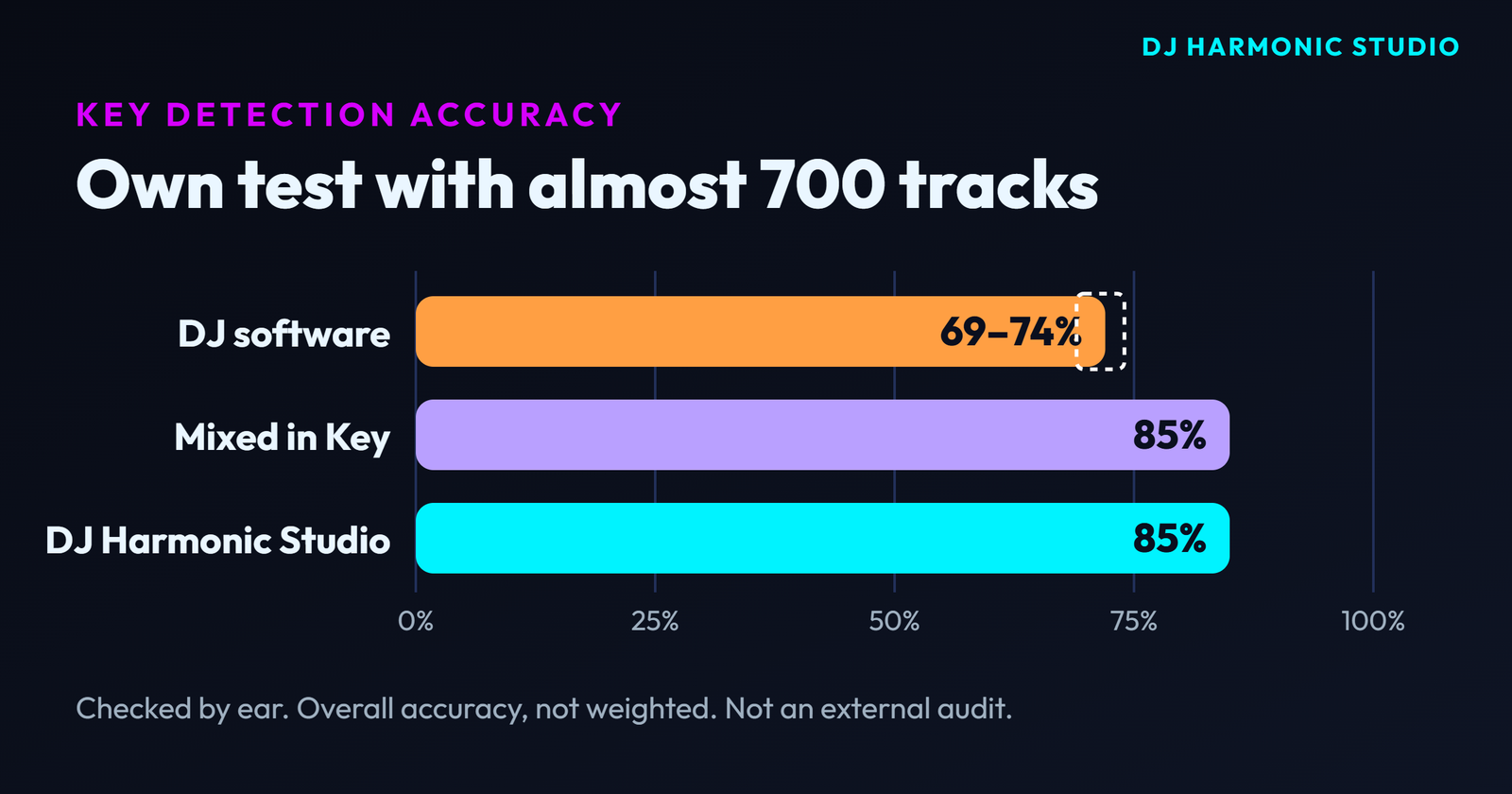
    Key detection accuracy chart: DJ software between 69 and 74 percent, Mixed in Key 85 percent and DJ Harmonic Studio 85 percent
    Result of the own test, with almost 700 tracks checked by ear.
    CriteriaBy ear, DJ software or Mixed in KeyDJ Harmonic Studio
    Speed on a big libraryBy ear: hours, track by track. DJ software and Mixed in Key: fast.Fast: one click for the whole folder
    Key in the file nameUsually only in the track info, or depending on settings.Automatic: [Am] Artist - Track
    Energy and foldersHand-built playlists. Mixed in Key shows an energy level per track.Energy from 1 to 5 stars and folders by energy, genre or Genre > Energy
    Fixing a doubtful analysisDepends on the program.Preview and edit with a single key
    Key detection accuracy*By ear: depends on your training. DJ software: between 69% and 74%. Mixed in Key: 85%.85%

    * Ariel’s own test with almost 700 tracks checked by ear (overall accuracy, not weighted). It is not an external audit.

    In that test, DJ Harmonic Studio reached 85% accuracy, the same as Mixed in Key. What it adds is what comes next: it renames the tracks, builds the folders and exports to Rekordbox, Serato, Traktor, VirtualDJ and Engine DJ. It does not replace any of them, it complements them. It also does not build your set order; it shows key and energy so you decide on the spot.

    Our take

    If you are looking for a Mixed in Key alternative that, besides analysis, writes the key in the title and sorts your library into folders by energy and genre, DJ Harmonic Studio is the most logical choice. Two practical reasons:

    • Stars from 1 to 5. Energy uses the same scale as other DJ software, so your tracks read the same everywhere.
    • Faster workflow. Edit energy and key with a single key press and renaming is automatic. That is how any DJ, beginner, intermediate or pro, saves hours of prep per session compared with other analysis software.

    Try it with your own tracks, 50 free.

    How to organize a library for harmonic mixing

    1. Analyze. With one click, DJ Harmonic Studio reads your whole library and gives you key, energy and genre. If something does not match your ear, you fix it.
    2. Export. Sort by energy (1 to 5 scale), by genre or both, depending on your plan. Each track is renamed with its key, in standard notation (Am, C, F#m) or, if you prefer, Camelot.
    3. Import into your software. Rekordbox, Serato, Traktor, VirtualDJ or Engine DJ: the key shows on the deck without opening any panel.
    Pantalla de DJ Harmonic Studio con una lista de tracks analizados: tonalidad, energía de 1 a 5 en estrellas y género de cada uno
    DJ Harmonic Studio shows key, energy from 1 to 5 and genre for every track on a single screen (Spanish interface shown; the app also runs in English).
    DJ music library before and after analysis: files renamed with the key and sorted into folders by energy and genre
    From loose file names to a library sorted by key, energy and genre.

    A few details that help day to day: you can edit key and energy from the keyboard, there is a digital piano to compare basslines by ear, and you can normalize volume to −9 LUFS for club or −14 LUFS for social media.

    An honest note

    If you use Rekordbox and your tracks already have hot cues, export with the “create copy” option. That keeps the original untouched and you use the renamed copy.

    Common harmonic mixing mistakes

    • Mixing by BPM only. Tempo says nothing about melody or bass.
    • Treating the key as a guarantee. Analysis can fail; check by ear before you trust it.
    • Ignoring energy. Two compatible tracks can have very different energy.
    • Following a code without understanding the note. It tells you what to do, not why it works. Learning the circle in notes gives you your own judgment.

    Why DJ Harmonic Studio was born

    I am a musician, and from my first tracks I made sure every one was properly analyzed. When I noticed that analysis software kept getting keys wrong, I started working them out by ear and writing the key by hand at the start of every track name.

    That habit gave me a competitive edge: I knew exactly what I was mixing. But it cost me hours. To stop losing time, in January 2026 I started building DJ Harmonic Studio and launched it in late March, once I saw the results it gave me. Today more than 1,400 DJs have used it.

    Frequently asked questions

    Harmonic mixing, also called key mixing, is the technique of mixing tracks in compatible keys so melodies and basslines do not clash during the transition. It relies on the circle of fifths.

    Not to play, but it makes long blends sound intentional and helps you avoid clashes. It matters most in melodic electronic music, where overlapping basslines and melodies are exposed.

    You can work it out by ear with a piano or keyboard, or use key detection software. DJ Harmonic Studio analyzes the key, energy and genre of your whole library in one click, and you can preview and correct any result by ear.

    8A is A minor (Am). The number is the position on the wheel and the letter A means minor. Its closest neighbors are 7A (Dm), 9A (Em) and 8B (C).

    None in the map: the Camelot wheel is the circle of fifths with each key numbered 1 to 12 and a letter. The circle names keys as notes (Am, C), which shows which notes two tracks share. More in Camelot wheel vs circle of fifths.

    Yes. DJ Harmonic Studio analyzes key, energy and genre, renames your tracks and sorts them into folders. In Ariel’s own test with almost 700 tracks checked by ear it reached 85% accuracy, the same as Mixed in Key. It has 50 free tracks to try.

    It depends on your workflow. If you want one click to analyze a whole library, write the key in the track title, sort folders by energy and genre and export to Rekordbox, Serato, Traktor, VirtualDJ or Engine DJ, DJ Harmonic Studio is built for that. It runs on Windows, Mac and Linux and is optimized mainly for electronic music.

    Yes. DJ Harmonic Studio is compatible with Rekordbox, Serato, Traktor Pro, VirtualDJ and Engine DJ. It does not replace those programs: it prepares your library before it reaches them.

    Try it with your library

    Analyze your first 50 tracks for free

    Get the key written in the title and your music in folders by energy and genre, ready for Rekordbox, Serato, Traktor, VirtualDJ or Engine DJ.

    Instant download · No credit card · Windows, Mac and Linux · Optimized for electronic music

    About me

    Ariel Contreras

    I studied a Bachelor’s in Music with a focus on Composition and a Technical Degree in Arrangement, and I have played piano and synthesizer since 2007. I have always been a composer, in other musical styles; in 2018 I ventured into electronic music, blending it with other genres, and since 2022 I have focused fully on electronic music production: my latest EP reached #27 in Melodic House on Beatport. I have been a DJ since early 2024. Between 2025 and 2026 I helped more than 235 people understand harmony for their mixes and productions.

    I created DJ Harmonic Studio, which more than 1,400 DJs have used. Try it free with your library: it is available for Windows, Mac and Linux and optimized mainly for electronic music.
    DJ Harmonic Studio  ·  © 2026 All rights reserved
  • Rueda de Camelot vs círculo de quintas: cuál conviene usar

    Rueda de Camelot vs círculo de quintas: cuál conviene usar

    Mezcla armónica

    Rueda de Camelot vs círculo de quintas: cuál conviene usar

    Los dos describen el mismo mapa de tonalidades, pero uno te da una etiqueta y el otro te da criterio. Qué diferencia hay y cuál conviene aprender si querés mezclar mejor.

    Por Ariel Contreras  ·  Noviembre 2026  ·  7 min de lectura

    Rueda de Camelot con códigos junto al círculo de quintas con notas, comparando los dos sistemas

    Hay una pregunta que se repite entre DJs: ¿la Rueda de Camelot y el círculo de quintas son cosas distintas, y cuál conviene usar? La respuesta corta: son el mismo mapa, pero cambia lo que ganás al leerlo.

    Respuesta rápida

    La Rueda de Camelot y el círculo de quintas representan lo mismo: las 24 tonalidades ordenadas por quintas. Camelot las numera (8A, 8B) y el círculo las nombra (Am, C). Para decidir rápido en cabina, el código alcanza; para entender por qué una mezcla funciona y llevarlo a la producción, conviene el círculo de quintas leído en notas.

    Son el mismo mapa con dos etiquetas

    Los dos ordenan las 12 notas de a una quinta de distancia, con el anillo exterior para las tonalidades mayores y el interior para sus relativas menores. Lo único que cambia es cómo se rotula cada casilla:

    Círculo de quintas con cada casilla rotulada con su nota y su código Camelot: Am es 8A
    El mismo círculo, con cada casilla rotulada con su nota y su código.
    • Rueda de Camelot: cada casilla lleva un número del 1 al 12 y una letra (A para menor, B para mayor). Am es 8A y C es 8B.
    • Círculo de quintas: cada casilla lleva el nombre de la tonalidad. Am es La menor y C es Do mayor.

    Por eso mezclar con Camelot (mismo número, un paso al costado, cambio de letra) y mezclar con el círculo (misma tonalidad, quinta arriba o abajo, relativa) son exactamente los mismos movimientos.

    Qué es la Rueda de Camelot y para qué sirve

    Es un sistema de códigos creado por Mark Davis, de Camelot Sound, que popularizó Mixed in Key y que hoy se puede mostrar en programas como Rekordbox o VirtualDJ. Traktor usa una variante, llamada Open Key. Sirve para decidir rápido: si lo que suena es 8A, los candidatos son 7A, 9A y 8B.

    Rueda de Camelot de colores con 8A resaltada y sus equivalencias en notas: 8A es Am, 9A es Em, 7A es Dm y 8B es C
    La Rueda de Camelot es el mismo círculo con códigos: 8A es Am, 9A es Em, 7A es Dm y 8B es C.

    Su gran ventaja es la velocidad de lectura: un número y una letra se leen de un vistazo, sin saber teoría musical.

    Hasta dónde llega un código

    El problema es lo que un código no te dice:

    Comparación: el código 8A no muestra qué notas tiene y la nota Am sí muestra sus siete notas A B C D E F G
    Un código no muestra qué notas tiene el track; la nota sí.
    • Qué notas tiene el track ni cuáles comparte con el siguiente.
    • Por qué dos tonalidades funcionan juntas ni cuándo van a rozar.
    • Cómo llevarlo a un teclado, a un DAW o a una charla con otro músico.
    • Qué hacer cuando el movimiento no alcanza: un bajo a semitono o una melodía que insiste en una nota que cambia.

    Además hay más de una numeración del mismo círculo (Camelot, Open Key y otras). Si cambiás de programa, el 8A de uno puede ser otro número en el otro. Las notas, en cambio, son las mismas en todos lados.

    Qué te da el círculo de quintas en notas

    Leído en notas, el círculo te da lo que el código esconde: ves de entrada qué está pasando.

    Las notas de Am y Em: comparten seis y solo cambia una, F pasa a F#
    De Am a Em comparten seis notas y solo cambia una: el F pasa a ser F#.
    • Vecinas, casi las mismas notas: dos tonalidades contiguas comparten seis de sus siete notas.
    • Sabés qué cambia: de Am a Em cambia una sola nota, el F pasa a ser F#.
    • Ves el riesgo: si la melodía del track que sale insiste en F, el que entra en Em va a rozar.
    • Te sirve fuera de la cabina: acordes, cadencias, bajos y progresiones en la producción son el mismo círculo.

    Con notas, la mezcla deja de ser obedecer una etiqueta y pasa a ser una decisión informada.

    Un mismo caso, dos lecturas

    Imaginá que suena un track en Am y querés pasar a uno en Em. Así lo ves con cada sistema:

    Con códigos

    8A → 9A
    Camelot: posición 8 → posición 9

    Sabés que es compatible. No sabés qué cambia ni dónde puede haber roce.

    Con notas

    Am → Em
    La menor → Mi menor

    Sabés que cambia una sola nota (F pasa a F#). Si el lead insiste en F, ya sabés dónde escuchar.

    Comparativa: Camelot vs círculo de quintas

    CriterioRueda de CamelotCírculo de quintas (notas)
    Lectura inicialMuy rápida: un número y una letraPide aprender las notas del círculo
    Qué te diceSi dos tonalidades son vecinasQué notas comparten y qué cambia
    Explica por qué funcionaNoSí
    Sirve fuera del DJ set (teclado, DAW)NoSí
    Entre programasVarias numeraciones (Camelot, Open Key)Las mismas notas en todos
    Curva de aprendizajeCasi nulaUn poco al principio, después se vuelve automática

    Camelot gana en el primer minuto; el círculo gana a medida que lo usás.

    Cuál conviene usar

    Nuestra recomendación

    Aprendé el círculo de quintas en notas y usá los códigos Camelot como atajo mientras tanto. Los códigos te dicen qué hacer; las notas te dicen por qué, y eso es lo que te permite decidir cuando la etiqueta no alcanza.

    Es también la razón por la que DJ Harmonic Studio escribe la tonalidad al inicio del título en notas (Am, C, F#m) y te deja elegir Camelot si preferís.

    Rueda de Camelot con notas: tabla de equivalencias

    Si venís de los códigos, esta tabla te sirve de puente. Las tonalidades menores llevan la letra A y las mayores la B.

    Menores (letra A)
    Abm1AEbm2ABbm3AFm4ACm5AGm6ADm7AAm8AEm9ABm10AF#m11ADbm12A
    Mayores (letra B)
    B1BF#2BDb3BAb4BEb5BBb6BF7BC8BG9BD10BA11BE12B

    Algunos programas escriben C#m en lugar de Dbm o G#m en lugar de Abm: es la misma nota.

    Cómo pasar de códigos a notas sin perder velocidad

    1. Escribí la tonalidad en notas en el título de cada track. Con DJ Harmonic Studio es automático: [Am] Artista - Track.
    2. Dejá la tabla de equivalencias a mano las primeras sesiones, como puente.
    3. Practicá con las tres vecinas de una tonalidad: quinta arriba, quinta abajo y relativa. Con Am son Em, Dm y C.
    4. Cuando dudes, escuchá. El análisis puede equivocarse y el oído tiene la última palabra.
    Pantalla de DJ Harmonic Studio con una lista de tracks analizados: tonalidad, energía de 1 a 5 en estrellas y género de cada uno
    DJ Harmonic Studio escribe la tonalidad en el título y la muestra en la lista; podés elegir notas o Camelot.

    Errores comunes

    • Creer que el código es una regla. Es un mapa: compatible no es sinónimo de que suene bien.
    • Repetir el mismo movimiento en todos los cambios. La energía se estanca y el set se vuelve predecible.
    • Ignorar los bajos. Dos tonalidades vecinas pueden chocar si los bajos quedan a un semitono.
    • Mezclar numeraciones. No confundas Camelot con Open Key al leer los códigos de otro programa.

    Preguntas frecuentes

    Sí. Ordenan las mismas 24 tonalidades por quintas. La Rueda de Camelot las rotula con códigos (por ejemplo, 8A) y el círculo de quintas con notas (por ejemplo, Am).

    Conviene el círculo de quintas leído en notas: te muestra qué notas comparten dos tracks, explica por qué una mezcla funciona y se aplica también en el teclado y en la producción. Los códigos Camelot sirven como atajo mientras te acostumbrás.

    Es un sistema de códigos para las 24 tonalidades, creado por Mark Davis, de Camelot Sound, y popularizado por Mixed in Key. Cada tonalidad lleva un número del 1 al 12 y una letra: A para menor y B para mayor.

    Con una tabla de equivalencias: la letra A indica menor y la B mayor. Por ejemplo, 8A es Am, 9A es Em, 7A es Dm y 8B es C. La tabla completa está más arriba en este artículo.

    Es otra numeración del mismo círculo de quintas, que usa Traktor. Cambian los números y las letras respecto de Camelot, pero la lógica es la misma.

    Estos programas permiten elegir en sus preferencias el formato de la tonalidad (notas o códigos). Lo más simple es escribir la tonalidad en notas en el título del track, y DJ Harmonic Studio lo hace automáticamente.

    Podés elegir: notación estándar (Am, C, F#m) o Camelot. Además renombra el track con la tonalidad al inicio del título, así la ves en el deck de Rekordbox, Serato, Traktor, VirtualDJ y Engine DJ. Tiene 50 tracks gratis para probarlo.

    Podés sacarla de oído con un piano o un teclado, o usar un programa que la detecte. DJ Harmonic Studio analiza la tonalidad, la energía y el estilo de toda tu biblioteca con un clic, y podés preescuchar y corregir cualquier resultado de oído.

    Para DJs, DJ Harmonic Studio: analiza toda la biblioteca con IA, escribe la tonalidad al inicio del título (por ejemplo, [Am] Artista – Track) y exporta a Rekordbox, Serato, Traktor, VirtualDJ y Engine DJ. Funciona en Windows, Mac y Linux y tiene 50 tracks gratis para probarlo.

    Probalo con tu biblioteca

    Analizá tus primeros 50 tracks gratis

    Dejá la tonalidad escrita en el título y tu música en carpetas por energía y estilo, lista para Rekordbox, Serato, Traktor, VirtualDJ o Engine DJ.

    Descarga inmediata · Sin tarjeta · Windows, Mac y Linux · Optimizado para música electrónica

    Sobre mí

    Ariel Contreras

    Estudié la Licenciatura en Música con orientación en Composición y la Tecnicatura en Arreglos, y toco piano y sintetizador desde 2007. Siempre fui compositor, en otros estilos musicales; en 2018 incursioné en la música electrónica, combinándola con otros géneros, y desde 2022 produzco música electrónica de lleno: mi último EP llegó al puesto 27 de Melodic House en Beatport. Soy DJ desde inicios de 2024. Entre 2025 y 2026 ayudé a más de 235 personas a entender armonía para sus mezclas y producciones.

    Creé DJ Harmonic Studio, que ya usaron más de 1.400 DJs. Probalo gratis con tu biblioteca: está disponible para Windows, Mac y Linux y está optimizado principalmente para música electrónica.

    DJ Harmonic Studio  ·  © 2026 Todos los derechos reservados
  • Mezcla armónica para DJs: guía del círculo de quintas

    Mezcla armónica para DJs: guía del círculo de quintas

    Mezcla armónica

    Mezcla armónica para DJs: guía del círculo de quintas

    Cómo leer el círculo de quintas para decidir qué track mezclar, y por qué conviene pensar en notas (Am, C, Em) y dejar de depender de la Rueda de Camelot.

    Por Ariel Contreras  ·  Noviembre 2026  ·  8 min de lectura

    Círculo de quintas con tonalidades mayores y menores sobre ondas de audio

    Estás en plena sesión. El track que viene entra perfecto de BPM y, aun así, suena mal. Dos melodías peleándose. La pista lo nota. Vos también.

    Pasa por un detalle que se mira tarde: la tonalidad. La mezcla armónica la usa como criterio para decidir qué track puede convivir con cuál, y su herramienta es el círculo de quintas. Esta guía explica cómo leerlo en notas, cuándo alcanza y cuándo conviene dejar la etiqueta y escuchar.

    Respuesta rápida

    La mezcla armónica consiste en combinar tracks con tonalidades compatibles para que melodías y bajos suenen en armonía durante la transición. Se apoya en el círculo de quintas: son compatibles la misma tonalidad, sus dos vecinas (una quinta arriba y una quinta abajo) y su relativa (de menor a mayor). La Rueda de Camelot es ese mismo círculo, con números.

    Por qué suena mal aunque el BPM coincida

    El BPM alinea el ritmo. La tonalidad alinea la melodía y, sobre todo, el bajo. Cuando dos tracks suenan a la vez, sus notas se suman: si los bajos quedan a un semitono, o aparece un tritono o una séptima mayor entre las voces, el oído lo registra como choque.

    Ondas de audio: Am con Em forman una onda regular y Am con Bbm una onda con cancelaciones que choca
    Dos tonalidades compatibles se suman en una onda ordenada; dos que chocan, no.

    Con tonalidades compatibles pasa lo contrario: las notas de un track caben dentro de la escala del otro y podés dejarlos convivir más tiempo. Esa diferencia separa una transición correcta de una que fluye.

    El círculo de quintas: el mapa de las 12 tonalidades

    El círculo de quintas ordena las 12 notas de modo que cada paso hacia la derecha sube una quinta (de C a G, de G a D, de D a A) y suma una alteración a la armadura. El anillo exterior son las tonalidades mayores y el interior sus relativas menores: Am queda debajo de C porque comparten exactamente las mismas notas.

    • Vecinas: dos tonalidades contiguas comparten seis de sus siete notas. C y G solo se distinguen por un F que pasa a ser F#.
    • Relativas: una mayor y su menor comparten las siete notas, como C y Am.
    • Distancia: cuanto más lejos en el círculo, más notas distintas y más riesgo de choque.
    Círculo de quintas de colores, una tonalidad por color; resalta Am y sus vecinas Dm, Em y C
    Con Am en el deck, las casillas magenta (Dm, Em y C) son las vecinas más cercanas.

    En esta guía leemos las tonalidades en notas (Am, C, F#m): es como las escribe un músico y como queda escrita en el título de tus tracks. Con un poco de práctica, la relación entre vecinas se ve sola.

    Cuatro movimientos para empezar

    Cuando no sabés cómo salir de un track, estos cuatro movimientos son un buen punto de partida:

    Círculo de quintas con los cuatro movimientos desde Am numerados del 1 al 4: misma tonalidad, quinta arriba, quinta abajo y relativa
    Los cuatro movimientos desde Am: 1 misma tonalidad, 2 quinta arriba, 3 quinta abajo y 4 relativa.

    Misma tonalidad

    Am → Am
    La menor → La menor

    La transición se vuelve casi invisible.

    Una quinta arriba

    Am → Em
    La menor → Mi menor

    Sube la energía de forma suave.

    Una quinta abajo

    Am → Dm
    La menor → Re menor

    Baja la tensión sin cortar el flow.

    Relativa

    Am → C
    La menor → Do mayor

    Mismas notas, otro ánimo: pasás de menor a mayor.

    Para animarse

    Subir dos quintas (Am → Bm) da un salto de energía marcado. Reservalo para un momento de drop.

    Ninguno garantiza nada por sí solo: el análisis puede equivocarse, y dos tracks en la misma tonalidad pueden chocar si el bajo y la melodía no se llevan. Por eso la última palabra la tiene el oído.

    Un set de cinco tracks, paso a paso

    Así se ve en un set. Cinco tracks, cuatro transiciones:

    Recorrido de un set de cinco tracks en el círculo de quintas: Am, Em, Bm, D y G
    El recorrido del set de ejemplo sobre el círculo: de Am a G en cuatro pasos.
    Am5ª ↑→Em5ª ↑→Bmrelativa→D5ª ↓→G

    La flecha ↑ marca una quinta arriba y ↓ una quinta abajo. El set sube de energía, cambia de color al pasar a mayor y vuelve a bajar, todo con movimientos de un paso. Lo que lleva tiempo es llegar a esa lista con la tonalidad de cada track ya resuelta.

    Dónde se complica: la tonalidad no está a la vista

    Con 100 tracks nuevos, analizarlos y renombrarlos a mano es un trabajo de horas, y cuando terminás la tonalidad suele quedar dentro de la ficha del track. En cabina tenés que abrir la info para saber qué estás mezclando.

    Cien tracks con la tonalidad sin resolver y un reloj: analizarlos a mano lleva horas
    Con 100 tracks nuevos, resolver la tonalidad a mano lleva horas.

    Resultado: mezclás sin arriesgar o arriesgás sin saber. Tu oído no tiene la culpa: la información no está a la vista cuando la necesitás. Para resolverlo sin hacerlo a mano existe el análisis automático de DJ Harmonic Studio.

    Y la Rueda de Camelot, ¿dónde entra?

    Programas como Mixed in Key o Rekordbox muestran la tonalidad con códigos tipo 8A o 9B. Es la Rueda de Camelot: el mismo círculo de quintas, con cada tonalidad numerada del 1 al 12 y una letra (A para menor, B para mayor).

    Rueda de Camelot de colores con 8A resaltada y sus equivalencias en notas: 8A es Am, 9A es Em, 7A es Dm y 8B es C
    La Rueda de Camelot es el mismo círculo con códigos: 8A es Am, 9A es Em, 7A es Dm y 8B es C.
    Am = 8AEm = 9ADm = 7AC = 8BBm = 10AD = 10BG = 9B
    Equivalencias de las tonalidades de este artículo.

    Sirve para descifrar lo que ves en pantalla, y poco más. Un código no te dice qué notas tiene el track, ni por qué dos tonalidades funcionan juntas, ni cómo llevarlo a un teclado, a una sesión de producción o a una charla con otro músico. Con las notas sí.

    Por eso conviene acostumbrarse a leer Am, C o F#m. Cuando entendés el círculo en notas, dejás de depender de una etiqueta y ganás criterio propio, que es lo que se nota en la pista.

    Comparativa: cómo conseguir la tonalidad de tu música

    Hay tres caminos habituales. La tabla los compara en lo que cambia el día a día de preparar una biblioteca.

    Gráfico de acierto en tonalidad: software DJ entre 69 y 74 por ciento, Mixed in Key 85 por ciento y DJ Harmonic Studio 85 por ciento
    Resultado de la prueba propia, sobre casi 700 tracks chequeados de oído.
    CriterioA oído, software DJ o Mixed in KeyDJ Harmonic Studio
    Velocidad con una biblioteca grandeA oído: horas, track por track. Software DJ y Mixed in Key: rápida.Rápida: un clic para toda la carpeta
    Tonalidad en el nombre del archivoNormalmente solo en la ficha del track, o según configuración.Automática: [Am] Artista - Track
    Energía y carpetasPlaylists armadas a mano. Mixed in Key indica la energía de cada track.Energía de 1 a 5 y carpetas por energía, por estilo o Género > Energía
    Corregir un análisis dudosoDepende del programa.Preescucha y edición con una tecla
    Acierto en tonalidad*A oído: depende de tu entrenamiento. Programas DJ: entre 69 y 74%. Mixed in Key: 85%.85%

    * Prueba propia de Ariel con casi 700 tracks chequeados de oído (acierto total, no ponderado). No es una auditoría externa.

    En esa prueba, DJ Harmonic Studio alcanzó un 85% de acierto, la misma precisión que Mixed in Key. Lo que suma es lo que viene después: renombra los tracks, arma las carpetas y exporta a Rekordbox, Serato, Traktor, VirtualDJ y Engine DJ. No reemplaza a ninguno de esos programas: los complementa. Tampoco arma el orden de tu set; muestra tonalidad y energía para que decidas vos en el momento.

    Nuestra lectura

    Si buscás una alternativa a Mixed in Key que, además del análisis, deje la tonalidad escrita en el título y la biblioteca en carpetas por energía y estilo, DJ Harmonic Studio es la opción más lógica. Dos razones prácticas:

    • Estrellas de 1 a 5. La energía se marca con la misma escala que usan los demás programas DJ, así tus tracks se leen igual en cualquiera de ellos.
    • Flujo más rápido. Editás energía y tonalidad con una sola tecla y el renombrado es automático. Con eso, cualquier DJ, novato, intermedio o profesional, ahorra horas de trabajo por sesión frente a los demás softwares de análisis.

    Probalo con tus tracks, 50 gratis.

    Cómo ordenar una biblioteca para mezclar en armonía

    1. Analizá. Con un clic, DJ Harmonic Studio lee toda la música y te da tonalidad, energía y estilo. Si algo no coincide con tu oído, lo corregís.
    2. Exportá. Elegís si ordenar por energía (escala de 1 a 5), por estilo o ambas, según tu plan. Cada track queda renombrado con su tonalidad, en cifrado americano (Am, C, F#m) o, si preferís, en Camelot.
    3. Importá en tu programa. Rekordbox, Serato, Traktor, VirtualDJ o Engine DJ: la tonalidad se ve en el deck sin abrir ninguna ficha.
    Pantalla de DJ Harmonic Studio con una lista de tracks analizados: tonalidad, energía de 1 a 5 en estrellas y género de cada uno
    DJ Harmonic Studio muestra la tonalidad, la energía de 1 a 5 y el género de cada track en una sola pantalla.
    Biblioteca de DJ antes y después de analizar: archivos renombrados con la tonalidad y ordenados en carpetas por energía y estilo
    De nombres sueltos a una biblioteca ordenada por tonalidad, energía y estilo.

    Un par de detalles que ayudan en el día a día: podés editar tonalidad y energía desde el teclado, hay un piano digital para comparar bajos de oído, y se puede igualar el volumen a −9 LUFS para club o −14 LUFS para redes.

    Un dato honesto

    Si usás Rekordbox y tus tracks ya tienen Hot Cues, exportá con la opción “crear copia”. Así conservás el original intacto y usás la copia ya renombrada.

    Errores comunes

    • Mezclar solo por BPM. El tempo no dice nada de la melodía ni del bajo.
    • Tratar la tonalidad como garantía. El análisis puede fallar; corroborá de oído antes de confiar.
    • Ignorar la energía. Dos tracks compatibles pueden tener energías muy distintas.
    • Seguir un código sin entender la nota. Te dice qué hacer, pero no por qué funciona. Aprender el círculo en notas te da criterio propio.

    Por qué nació DJ Harmonic Studio

    Soy músico, y desde mis primeros tracks me preocupé por que cada uno estuviera bien analizado. Cuando noté que los programas de análisis fallaban, empecé a sacar todo de oído y a anotar a mano la tonalidad al inicio del nombre de cada track.

    Esa costumbre me dio una ventaja competitiva: sabía exactamente qué estaba mezclando. Pero me costaba horas. Para no seguir perdiendo tiempo, en enero de 2026 empecé a desarrollar DJ Harmonic Studio y lo lancé a fines de marzo, al ver los resultados que me daba a mí. Hoy ya lo usaron más de 1.400 DJs.

    Preguntas frecuentes

    Es un diagrama que ordena las 12 notas a una quinta de distancia una de otra. Sirve para ver qué tonalidades comparten casi todas sus notas y, por lo tanto, cuáles se pueden mezclar con menos riesgo de choque.

    Es la técnica de combinar tracks con tonalidades compatibles para que las melodías y los bajos no choquen en la transición. Se apoya en el círculo de quintas.

    La Rueda de Camelot es el círculo de quintas con cada tonalidad numerada del 1 al 12 y una letra (A para menor, B para mayor). Por ejemplo, Am es 8A y C es 8B. Es la misma información, escrita con códigos en lugar de notas.

    Sí, con transiciones cortas, cortes de graves o efectos que tapen el solapamiento. Con tonalidades compatibles tenés más margen, pero la última palabra la tiene el oído.

    Conviene leer notas (Am, C, F#m): te muestran qué notas comparten dos tracks, sirven en el teclado y en el DAW y las entiende cualquier músico. Los códigos son útiles para descifrar lo que muestran algunos programas. DJ Harmonic Studio te deja elegir cuál escribir en el título.

    Sí. DJ Harmonic Studio analiza tonalidad, energía y estilo, renombra los tracks y los ordena en carpetas. En la prueba propia de Ariel con casi 700 tracks chequeados de oído alcanzó un 85% de acierto, la misma precisión que Mixed in Key. Tiene 50 tracks gratis para probarlo.

    Sí. Es compatible con Rekordbox, Serato, Traktor Pro, VirtualDJ y Engine DJ, y funciona en Windows, Mac y Linux. No reemplaza a esos programas: prepara la biblioteca antes de que lleguen a ellos.

    Podés sacarla de oído con un piano o un teclado, o usar un programa que la detecte. DJ Harmonic Studio analiza la tonalidad, la energía y el estilo de toda tu biblioteca con un clic, y podés preescuchar y corregir cualquier resultado de oído.

    Para DJs, DJ Harmonic Studio: analiza toda la biblioteca con IA, escribe la tonalidad al inicio del título (por ejemplo, [Am] Artista – Track) y exporta a Rekordbox, Serato, Traktor, VirtualDJ y Engine DJ. Funciona en Windows, Mac y Linux y tiene 50 tracks gratis para probarlo.

    Para decidir qué tracks pueden mezclarse sin que choquen las melodías ni los bajos, y para entender qué notas comparten. Es la base de la mezcla armónica.

    Probalo con tu biblioteca

    Analizá tus primeros 50 tracks gratis

    Dejá la tonalidad escrita en el título y tu música en carpetas por energía y estilo, lista para Rekordbox, Serato, Traktor, VirtualDJ o Engine DJ.

    Descarga inmediata · Sin tarjeta · Windows, Mac y Linux · Optimizado para música electrónica

    Sobre mí

    Ariel Contreras

    Estudié la Licenciatura en Música con orientación en Composición y la Tecnicatura en Arreglos, y toco piano y sintetizador desde 2007. Siempre fui compositor, en otros estilos musicales; en 2018 incursioné en la música electrónica, combinándola con otros géneros, y desde 2022 produzco música electrónica de lleno: mi último EP llegó al puesto 27 de Melodic House en Beatport. Soy DJ desde inicios de 2024. Entre 2025 y 2026 ayudé a más de 235 personas a entender armonía para sus mezclas y producciones.

    Creé DJ Harmonic Studio, que ya usaron más de 1.400 DJs. Probalo gratis con tu biblioteca: está disponible para Windows, Mac y Linux y está optimizado principalmente para música electrónica.

    DJ Harmonic Studio  ·  © 2026 Todos los derechos reservados